The problem was never the models. It was the workflows.
Over the last few years, healthcare organizations have rapidly accelerated investments in AI across diagnostics, revenue cycle management, patient engagement, operational analytics, and clinical decision support. Yet despite the surge in innovation, most healthcare enterprises still struggle to operationalize AI beyond isolated pilots and disconnected use cases. At 47Billion, this is one of the most consistent patterns we see while working with healthcare systems navigating digital transformation initiatives.
Predictive models. Clinical copilots. Intelligent automation platforms. Diagnostic algorithms. Revenue cycle tools. Operational dashboards.
Yet despite the investment, most healthcare AI implementation initiatives never move beyond pilots.
The issue is not a lack of innovation.
Healthcare already has highly capable AI technologies.
The real problem is operational adoption.
Across hospitals and health systems, AI often struggles to integrate into the daily realities of clinicians, operational teams, administrators and care coordinators. Models may perform well in controlled environments, but fail to create measurable transformation once deployed at scale.
This gap between technical capability and operational usability is becoming one of the biggest healthcare AI implementation challenges in healthcare transformation.
The challenge is not model capability anymore. Most healthcare AI models today are technically sophisticated. The real challenge lies in integrating intelligence into highly dynamic operational ecosystems where workflows span clinicians, administrators, biomedical teams, payers, and patients simultaneously.
We believe healthcare AI succeeds only when intelligence is embedded directly into operational workflows instead of existing as standalone analytical layers.
Most AI systems in healthcare are designed to generate insights.
Very few are designed to fit naturally into:
- hospital operations
- clinician workflows
- staffing realities
- payer-provider coordination
- regulatory processes
- multi-department communication structures
As a result:
- alerts get ignored
- clinicians experience fatigue
- operational teams bypass systems
- recommendations never become actions
- AI becomes another disconnected dashboard instead of an operational layer
Healthcare workflows are dynamic, high-pressure and deeply interconnected. Any AI system that adds friction instead of reducing it will eventually fail clinical AI workflow integration.
1. AI Is Often Built in Isolation From Clinical Reality
One of the biggest reasons AI adoption in hospital operations is because systems are developed around technical accuracy instead of workflow practicality.
An AI model may predict patient deterioration with 92% accuracy.
But operationally:
- Who receives the alert?
- What happens next?
- Which team owns escalation?
- How is staffing impacted?
- What if the clinician already has 15 other alerts?
Healthcare workflows involve dependencies across:
- staff
- physicians
- labs
- radiology
- pharmacy
- case management
- administration
Without operational orchestration, predictions become noise.
This is why many AI deployments stall after initial excitement.
For a deeper look at how data fragmentation affects healthcare systems, read our blog on healthcare interoperability and patient care.
2. Healthcare AI Often Creates More Cognitive Load Instead of Less
Clinicians already operate under extreme information overload.
Adding another:
- dashboard
- portal
- notification system
- risk score
- workflow application
often increases burnout instead of improving efficiency.
A common mistake is assuming clinicians want “more insights.”
What they actually need is:
- prioritization
- contextual recommendations
- automation of repetitive work
- coordinated workflows
- fewer manual handoffs
Healthcare AI operational adoption succeeds only when it reduces operational burden.
3. Fragmented Data Ecosystems Break AI Effectiveness
Healthcare systems remain heavily siloed.
Critical operational data is spread across:
- EHRs
- PACS
- LIS systems
- workforce management platforms
- billing systems
- device telemetry
- payer systems
Most AI models are trained in isolated environments but deployed into fragmented operational infrastructures.
This creates:
- incomplete context
- delayed decision-making
- unreliable outputs
- workflow interruptions
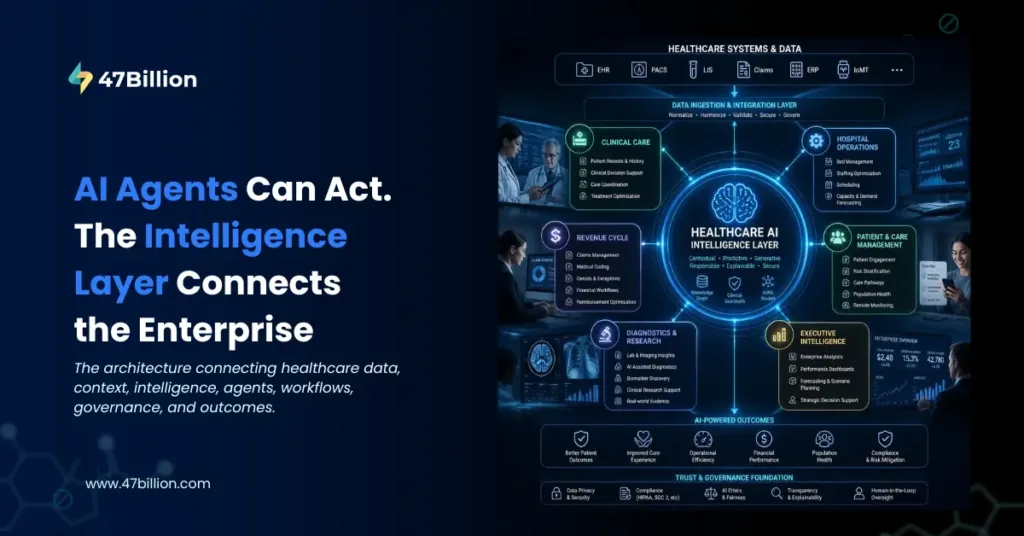
This is why healthcare enterprises increasingly require interoperable AI architectures capable of operating across fragmented ecosystems. From EHR integration and device telemetry to claims systems and operational platforms, healthcare AI must function as a connected intelligence layer rather than another isolated application.
Building this orchestration layer is where custom healthcare AI engineering becomes critical.
Learn how structured data extraction from EHRs is reshaping clinical intelligence: Extraction of Structured Data from EHRs Using NLP.
4. Most Healthcare AI Stops at Prediction Instead of Execution
Traditional healthcare AI is designed to answer:
“What might happen?”
Operational teams need systems that answer:
“What should happen next?”
This is where AI adoption in healthcare breaks down.
Example:
An AI model predicts discharge delays.
But unless the system can:
- coordinate transport
- notify housekeeping
- alert pharmacy
- communicate with case managers
- update bed allocation
the prediction creates no operational value.
Healthcare organizations are now realizing that predictive intelligence without workflow execution has limited impact.
Explore how predictive analytics is already driving measurable value in care delivery: Empowering Healthcare with Predictive Analytics.
5. Lack of Trust Slows Adoption Across Clinical Teams
Trust remains one of the largest barriers in healthcare AI adoption.
Clinicians are unlikely to rely on systems that:
- cannot explain decisions
- produce inconsistent outputs
- interrupt workflows
- operate as black boxes
Healthcare decisions carry legal, ethical and patient safety implications.
This makes explainability critical.
Successful AI systems provide:
- transparent reasoning
- auditability
- confidence scoring
- human override mechanisms
- governance checkpoints
Operational trust is earned through reliability and integration, not just accuracy metrics.
6. AI Governance Is Often an Afterthought
Many organizations move quickly into pilots without establishing:
- operational ownership
- escalation frameworks
- compliance structures
- human-in-the-loop controls
- accountability models
This creates uncertainty around:
- who validates outputs
- who is responsible for errors
- when AI recommendations should be overridden
- how risk is monitored
Healthcare AI cannot scale without governance maturity.
7. Operational Adoption Requires Organizational Change, Not Just Technology
AI changes how hospitals work.
That means healthcare AI operational adoption depends heavily on workforce readiness, process redesign, leadership alignment, change management, and training and education.
- workforce readiness
- process redesign
- leadership alignment
- change management
- training and education
Many organizations underestimate the cultural shift required.
Operational teams need to understand:
- where AI fits
- what it automates
- what remains human-controlled
- how workflows will evolve
Without this alignment, adoption resistance becomes inevitable.
Why Agentic AI May Finally Solve the Adoption Problem?
Healthcare is now moving beyond standalone AI models toward agentic AI systems.
This is a major shift.
Instead of generating isolated predictions, AI agents:
- coordinate workflows
- trigger operational actions
- communicate across systems
- manage dependencies
- escalate to humans when required
This makes AI operationally useful.
For example:
Instead of merely predicting equipment failure, a multi-agent system can:
- detect telemetry anomalies
- validate risk
- schedule maintenance
- notify biomedical engineering
- reroute affected procedures
- update operational schedules automatically
This is the difference between predictive AI and operational AI.
At 47Billion, we see agentic AI not as another automation trend, but as the next operational layer for healthcare enterprises. Traditional AI systems stop at generating predictions. Agentic systems go further by coordinating workflows, triggering operational actions, managing dependencies, and continuously adapting based on real-time conditions. This shift is particularly important in healthcare environments where delays in coordination directly affect patient outcomes, clinician workload, and operational efficiency.
See how generative AI is already beginning to reshape healthcare workflows: How Generative AI Is Reshaping the Healthcare Industry.
The Future of Healthcare AI Is Invisible
The most successful healthcare AI systems will not feel like “AI products.”
They will function quietly in the background:
- orchestrating workflows
- reducing friction
- automating coordination
- optimizing operations
- supporting clinicians without disrupting them
The goal is not to force hospitals to adapt to AI.
The goal is to make AI adapt to hospitals.
Healthcare AI was never meant to become another layer of dashboards, alerts, and disconnected intelligence.
Its real potential lies in transforming how healthcare systems operate at scale.
The hospitals that will lead the next decade of healthcare transformation will not simply adopt AI models. They will build intelligent operational ecosystems where workflows are interconnected, decisions are contextual, and systems can coordinate in real time across clinical, operational, and financial environments.
At 47Billion, we believe the future of healthcare belongs to organizations that move beyond isolated automation and embrace operational intelligence as a core strategic capability.
From interoperable AI architectures and predictive analytics to agentic workflows and intelligent orchestration systems, we help healthcare enterprises design scalable AI ecosystems that integrate seamlessly into real-world hospital operations.
Because in healthcare, transformation does not happen when systems generate more insights.
It happens when intelligence becomes operational.
Ready to build healthcare systems that can sense, predict, coordinate, and act in real time?
Partner with 47Billion to engineer AI-driven healthcare ecosystems designed for operational excellence, clinical efficiency, and scalable transformation.