AI in Healthcare is rapidly transforming how healthcare organizations deliver care, optimize operations, and improve patient outcomes. Healthcare has spent the last two decades digitizing care through Electronic Health Records (EHRs), cloud infrastructure, interoperability standards, and analytics platforms, creating the foundation for the next generation of AI-native healthcare enterprises.
Electronic Health Records (EHRs) replaced paper charts. Telehealth expanded access beyond hospital walls. Cloud computing modernized infrastructure. Interoperability standards such as HL7 FHIR enabled healthcare organizations to exchange information more effectively, while analytics platforms transformed vast volumes of clinical and operational data into dashboards and reports. These investments laid the foundation for a more connected healthcare ecosystem.
Yet despite this progress, many healthcare organizations continue to face familiar challenges. Clinicians spend significant portions of their day navigating multiple applications instead of caring for patients. Administrative teams manually reconcile fragmented information across disparate systems. Revenue cycle teams struggle with denials and documentation gaps. Hospital leaders often make operational decisions based on retrospective reports rather than real-time intelligence.
The challenge is no longer a lack of technology or data. Healthcare today generates more information than ever before, but much of it remains underutilized because it exists in disconnected workflows, isolated applications, and static decision support systems. Digital transformation has improved how healthcare organizations capture and exchange information, but it has not fundamentally changed how decisions are made.
The next era of healthcare will not be defined by organizations that have the most digital systems. It will belong to those that become AI-native.
An AI-native healthcare enterprise does not simply deploy artificial intelligence as another application layered on top of existing infrastructure. Instead, intelligence becomes an integral part of every clinical, operational, and administrative workflow. AI continuously interprets patient context, anticipates operational bottlenecks, orchestrates complex processes, and supports clinicians with timely, evidence-based recommendations while preserving human judgment where it matters most.
This shift represents a fundamental architectural evolution. Rather than treating AI as an isolated capability, AI-native organizations build intelligence into the very fabric of the enterprise. Data flows seamlessly across interoperable systems, semantic models provide clinical context, AI agents collaborate across departments, and workflow orchestration enables faster, safer, and more informed decision-making at scale.
At 47Billion, we believe the future of healthcare is not simply digital or AI-enabled. It is AI-native. Organizations that embrace this paradigm will move beyond automation to create healthcare systems that continuously learn, adapt, and improve, delivering better patient outcomes, greater operational resilience, and sustainable enterprise performance.
Organizations looking to operationalize enterprise intelligence can leverage Healthcare AI Solutions to modernize clinical workflows, automate operations, and accelerate AI adoption across the healthcare ecosystem.
The question is no longer whether healthcare organizations should adopt AI. The question is whether they are prepared to redesign their enterprise around intelligence. AI in Healthcare has moved beyond experimentation and is becoming a foundational capability for modern healthcare enterprises seeking to improve clinical, operational, and financial outcomes.
Why AI in Healthcare Is Accelerating AI-Native Transformation?
Several technological and market forces are converging to make AI-native healthcare both possible and necessary.
Over the past decade, healthcare organizations have invested heavily in cloud infrastructure, interoperability, digital care delivery, and enterprise data platforms. Standards such as HL7 FHIR have significantly improved data accessibility, while modern integration architectures have enabled information to move more seamlessly across clinical and operational systems.
Building truly intelligent healthcare systems also requires a modern approach to Healthcare Interoperability, where connected data evolves into connected intelligence.
At the same time, healthcare faces unprecedented pressures. Workforce shortages continue to strain clinicians and administrative teams. Value-based care models require organizations to manage patient populations more proactively. Rising operational costs, increasing patient expectations, and growing regulatory complexity have created an urgent need for smarter and more scalable ways of operating.
The emergence of foundation models, multimodal AI, and agentic systems represents a transformational breakthrough. For the first time, healthcare organizations can combine clinical knowledge, operational intelligence, and natural language reasoning within unified intelligent workflows.
AI-native healthcare is not simply the next technology trend. It is the result of a convergence of digital maturity, data availability, organizational necessity, and advances in artificial intelligence that collectively redefine what is possible across the healthcare enterprise.
What Is an AI-Native Healthcare Enterprise?
An AI-native healthcare enterprise embeds intelligence into every clinical, operational, and administrative workflow rather than treating AI as a standalone technology.
For many organizations, adopting AI means deploying a chatbot, implementing a predictive model, or embedding generative AI into existing software. While these initiatives deliver incremental value, they do not fundamentally change how the enterprise operates. They make digital systems more efficient, but they do not make the organization AI-native.
An AI-native healthcare enterprise takes a fundamentally different approach. Instead of treating artificial intelligence as an additional capability layered onto existing processes, it redesigns workflows, decision-making, and operations around intelligence from the outset. AI is no longer an isolated tool that users invoke when needed. It becomes an active participant in every stage of care delivery, continuously analyzing context, coordinating workflows, recommending actions, and learning from outcomes.
This distinction is significant. Traditional digital transformation focused on digitizing information and connecting systems. AI-native transformation focuses on augmenting human intelligence and enabling autonomous enterprise operations where appropriate. The objective is not simply to automate repetitive tasks but to create healthcare systems that can continuously sense, reason, decide, and orchestrate actions across clinical and operational domains.
Consider a patient arriving at the emergency department. In a conventional digital environment, clinicians manually navigate the Electronic Health Record (EHR), laboratory systems, imaging applications, medication histories, referral notes, and prior encounters to assemble a complete clinical picture. Each system provides information, but the responsibility for synthesizing that information rests entirely with the clinician.
In an AI-native environment, that process changes fundamentally. Before the clinician even begins the consultation, AI has already aggregated relevant patient history, highlighted abnormal laboratory trends, summarized previous admissions, identified medication conflicts, assessed clinical risk factors, surfaced applicable treatment guidelines, and recommended potential next steps based on similar patient populations. The physician remains the decision-maker, but arrives at the decision with comprehensive, contextual intelligence rather than fragmented information.
The same principle extends beyond clinical care. Revenue cycle operations proactively identify claims at risk of denial before submission. Capacity management continuously predicts bed availability and discharge bottlenecks. Operating room schedules adapt dynamically based on patient flow and staffing availability. Population health teams receive prioritized intervention opportunities before high-risk patients deteriorate. Rather than reacting to events after they occur, the enterprise anticipates them and responds proactively.
Learn how Care Management Intelligence helps healthcare organizations prioritize interventions based on clinical impact rather than risk alone.
The difference can be summarized simply:
| AI-Enabled Healthcare | AI-Native Healthcare |
| AI supports existing workflows. | AI redesigns workflows around intelligence. |
| Intelligence is available on demand. | Intelligence is continuously embedded into operations. |
| Teams search for insights. | Relevant insights are proactively delivered. |
| Automation focuses on individual tasks. | Orchestration spans end-to-end clinical and operational processes. |
| Systems exchange information. | Systems collaborate to enable coordinated decisions. |
| AI operates in isolated applications. | AI functions as an enterprise capability across the healthcare ecosystem. |
Becoming AI-native therefore requires more than deploying advanced models. It demands an enterprise architecture capable of combining interoperable data, semantic understanding, AI reasoning, workflow orchestration, governance, and human oversight into a unified intelligence ecosystem. Healthcare organizations that embrace this model will move beyond isolated AI pilots to create continuously learning enterprises where every interaction, every workflow, and every decision becomes progressively smarter over time.
The future of healthcare will not be shaped by organizations that simply use AI. It will be led by those that operate as AI-native enterprises, where intelligence is woven into the fabric of clinical care, operational excellence, and patient outcomes.
The Healthcare AI Maturity Journey
Healthcare organizations typically evolve through five stages of intelligence maturity:
| Stage | Characteristics |
| Digital Healthcare | EHRs, digitized workflows, electronic records |
| Data-Driven Healthcare | Analytics platforms, dashboards, reporting |
| AI-Enabled Healthcare | Predictive models, copilots, isolated AI solutions |
| AI-Orchestrated Healthcare | AI integrated into workflows and business processes |
| AI-Native Healthcare | Enterprise-wide intelligence, agentic orchestration, continuous learning |
Most health systems today operate between the AI-enabled and AI-orchestrated stages. The organizations that reach AI-native maturity will gain a sustainable advantage through faster decision-making, proactive operations, and continuously improving patient outcomes.
Core Building Blocks of an AI-Native Healthcare Enterprise
Becoming AI-native is not the result of implementing a single AI platform or deploying a collection of intelligent applications. It requires a deliberate transformation of the enterprise, where data, technology, people, and processes operate as an interconnected intelligence ecosystem. Organizations that successfully make this transition share a common set of foundational capabilities that enable AI to deliver value consistently across clinical, operational, and business functions.
1. Intelligence Embedded into Every Workflow
In traditional healthcare environments, AI often exists as a standalone capability that clinicians or administrators access when needed. AI-native organizations reverse this model by embedding intelligence directly into everyday workflows. Whether scheduling surgeries, reviewing imaging studies, managing chronic disease populations, or processing insurance claims, AI operates in the background, providing context, recommendations, and automation without disrupting existing clinical practices.
Instead of requiring users to search for insights, the system proactively delivers relevant intelligence at the moment decisions are made.
2. Unified and Trusted Healthcare Data
Artificial intelligence is only as effective as the data that powers it. Healthcare organizations often manage information distributed across Electronic Health Records (EHRs), Laboratory Information Systems (LIS), Radiology Information Systems (RIS), Pharmacy platforms, payer systems, IoMT devices, wearable technologies, and patient-generated health applications.
An AI-native enterprise establishes a unified healthcare data foundation through interoperability standards such as HL7 FHIR, real-time data integration, and enterprise data fabrics. More importantly, it ensures that data is governed, standardized, secure, and enriched with semantic meaning, creating a trusted source of intelligence rather than isolated repositories of information.
3. Context Before Intelligence
Clinical decisions rarely depend on individual data points. They require context.
A laboratory result has little meaning without the patient’s medical history. Imaging findings gain significance when correlated with medications, physician notes, genomic information, social determinants of health, and previous interventions.
AI-native healthcare organizations therefore build semantic layers using clinical ontologies, knowledge graphs, and standardized vocabularies to establish relationships between people, conditions, treatments, and outcomes. This contextual understanding enables AI systems to reason more effectively and produce recommendations that align with real-world clinical scenarios rather than isolated observations.
4. AI Agents That Collaborate Across the Enterprise
The future of healthcare AI extends beyond individual predictive models toward networks of specialized AI agents capable of collaborating across departments. Healthcare AI Agents are rapidly becoming a key component of enterprise healthcare platforms by coordinating clinical, financial, and operational activities.
Clinical agents assist physicians with diagnosis and treatment recommendations. Revenue cycle agents optimize coding accuracy and reduce denials. Operations agents predict patient flow and staffing requirements. Patient engagement agents coordinate appointments, education, and follow-up care.
Rather than functioning independently, these agents exchange information, coordinate decisions, and orchestrate complex workflows while operating within governance frameworks that ensure transparency, accountability, and human oversight.
From AI Copilots to AI Agents
Most healthcare organizations begin their AI journey with copilots that assist users by generating content, retrieving information, or answering questions.
AI agents represent the next stage of evolution.
While copilots support human activities, agents can independently execute tasks, coordinate workflows, monitor outcomes, and collaborate with other agents within defined governance boundaries.
For example, a documentation copilot may help a physician summarize a patient encounter. An AI agent could go much further by reviewing documentation, validating coding requirements, initiating prior authorization workflows, coordinating discharge preparation, and tracking task completion across multiple systems.
As healthcare becomes increasingly complex, organizations will rely on networks of specialized agents operating across clinical, financial, operational, and patient engagement workflows. These multi-agent ecosystems will function as a digital workforce that augments healthcare teams while preserving accountability, governance, and human oversight.
5. Human-Centered Intelligence
Healthcare will always remain fundamentally human.
AI-native organizations recognize that artificial intelligence should augment clinical expertise rather than replace it. Physicians, nurses, pharmacists, and care teams remain accountable for patient care, while AI reduces cognitive burden by synthesizing information, identifying patterns, and presenting evidence-based recommendations.
This human-in-the-loop approach strengthens clinician confidence, improves adoption, and ensures that technology enhances rather than disrupts the patient-provider relationship.
6. Continuous Learning and Adaptation
Unlike traditional software systems that remain relatively static after deployment, AI-native enterprises continuously evolve.
Every patient interaction, operational outcome, diagnostic decision, and clinical intervention contributes new knowledge to the organization. Machine learning models are refined using real-world evidence, workflows adapt to changing conditions, and decision-support systems improve over time through ongoing feedback and governance.
The healthcare enterprise becomes a learning system, capable of adapting to new diseases, emerging clinical guidelines, regulatory changes, and evolving patient populations without requiring large-scale redesign.
These characteristics collectively redefine what it means to operate a modern healthcare organization. AI-native enterprises are not distinguished simply by the number of AI models they deploy, but by their ability to integrate intelligence seamlessly into every layer of care delivery and enterprise operations.
The next step in this evolution is understanding how these capabilities come together architecturally. Building an AI-native healthcare enterprise requires a technology stack that combines interoperable data, semantic understanding, AI reasoning, and enterprise-wide orchestration into a cohesive intelligence platform.
The AI Technology Stack for Healthcare Enterprises
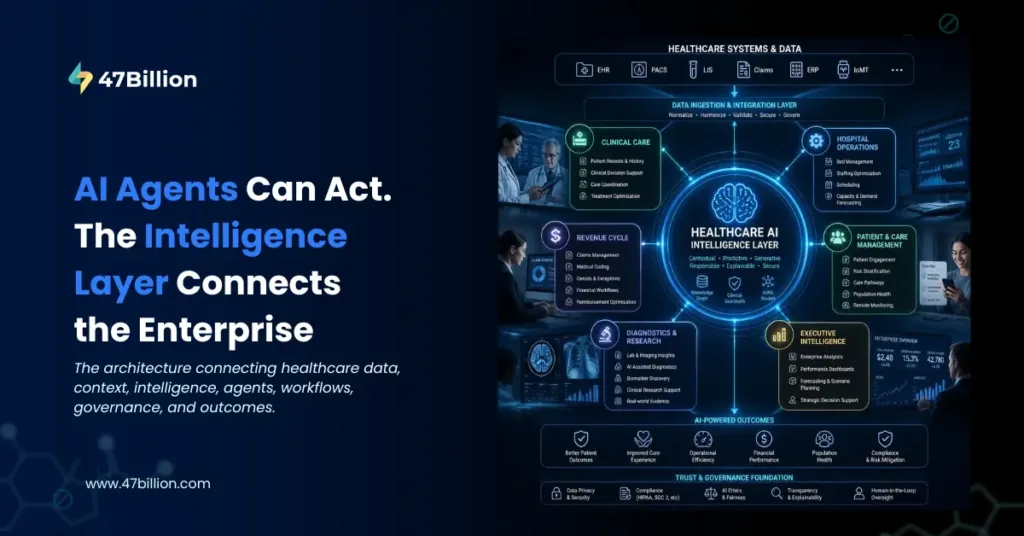
An AI-native healthcare enterprise is not built by introducing a single AI application or deploying a large language model alongside existing systems. It requires an architectural foundation where data, intelligence, automation, and governance operate as a unified ecosystem. Every layer of the technology stack must work together to transform fragmented healthcare information into timely, explainable, and actionable decisions.
Unlike traditional enterprise architectures, where applications primarily exchange data, an AI-native architecture enables systems to continuously interpret context, reason across multiple information sources, and orchestrate intelligent actions across the healthcare enterprise.
Clinical and Operational Systems
At the foundation are the systems that power day-to-day healthcare operations. Electronic Health Records (EHRs), Laboratory Information Systems (LIS), Radiology Information Systems (RIS), Pharmacy Management Systems, Revenue Cycle platforms, Enterprise Resource Planning (ERP), Customer Relationship Management (CRM), medical imaging platforms, IoMT devices, wearable technologies, and patient engagement applications generate an enormous volume of structured and unstructured data.
These systems remain the systems of record, but they were never designed to function as systems of intelligence. Information is distributed across multiple applications, often with varying formats, standards, and update frequencies, making it difficult to build a comprehensive view of patients, providers, and enterprise operations.
Interoperability and Data Integration
The next layer establishes seamless connectivity across the healthcare ecosystem through interoperability standards such as HL7, FHIR, SMART on FHIR, DICOM, X12, and TEFCA. APIs, integration engines, event-driven architectures, and Health Information Exchanges (HIEs) ensure that clinical, operational, and financial information can move securely between systems in near real time.
However, data movement alone does not create intelligence. While interoperability eliminates technical silos, organizations still require mechanisms to unify, govern, and contextualize the information flowing across the enterprise.
Healthcare Data Fabric
The Healthcare Data Fabric serves as the enterprise’s unified intelligence foundation. Rather than consolidating every dataset into a centralized repository, the data fabric creates a governed, virtualized layer that provides secure access to distributed healthcare information regardless of where it resides.
Clinical records, imaging metadata, claims information, genomics, social determinants of health, medical device streams, operational metrics, and patient-generated health data become accessible through a common architecture without disrupting existing systems.
This approach reduces data duplication, improves governance, accelerates analytics, and provides AI applications with consistent, high-quality information across the enterprise.
Semantic Intelligence Layer
Healthcare data becomes meaningful only when relationships are understood.
The Semantic Intelligence Layer enriches enterprise data using clinical ontologies, knowledge graphs, standardized vocabularies such as SNOMED CT, LOINC, ICD-10, RxNorm, and FHIR resources, enabling AI systems to interpret information within its clinical and operational context.
Instead of viewing isolated laboratory values or physician notes, AI understands relationships between diagnoses, medications, procedures, care pathways, providers, facilities, and longitudinal patient histories. This semantic understanding dramatically improves reasoning accuracy, explainability, and clinical relevance.
Enterprise AI Intelligence Layer
This is where the enterprise transitions from connected information to connected intelligence.
The Intelligence Layer combines machine learning models, predictive analytics, foundation models, generative AI, retrieval-augmented generation (RAG), multimodal AI, and clinical reasoning engines to continuously analyze enterprise-wide information.
Rather than simply generating content or predictions, these capabilities identify emerging clinical risks, recommend evidence-based interventions, forecast operational bottlenecks, optimize resource allocation, detect revenue leakage, and support population health initiatives through continuous decision intelligence.
Every recommendation is informed by enterprise context rather than isolated datasets.
Agentic Orchestration Layer
The defining characteristic of an AI-native healthcare enterprise is not the presence of AI models but the ability to coordinate intelligent actions across departments.
Specialized AI agents collaborate to automate complex workflows spanning clinical care, revenue cycle management, patient engagement, workforce optimization, compliance, and hospital operations.
For example, a patient’s admission can simultaneously trigger documentation assistance, laboratory prioritization, bed allocation, pharmacy coordination, discharge planning, payer authorization, and patient communication through orchestrated AI agents operating within predefined governance policies.
Instead of isolated automation, healthcare organizations achieve coordinated enterprise execution.
Governance, Security, and Responsible AI
Intelligence without governance introduces unacceptable clinical and regulatory risk.
An AI-native architecture incorporates security, privacy, explainability, model monitoring, bias detection, human oversight, auditability, and regulatory compliance as foundational capabilities rather than afterthoughts.
Every AI recommendation must remain transparent, traceable, clinically accountable, and compliant with evolving healthcare regulations. Responsible AI ensures that intelligence enhances clinician confidence while maintaining patient safety and organizational trust.
An AI-native technology stack does far more than modernize IT infrastructure. It establishes an enterprise-wide intelligence platform where interoperable data, semantic understanding, AI reasoning, and autonomous orchestration operate together to support every clinical, operational, and business decision.
The organizations that adopt this architecture will not simply deliver faster healthcare. They will deliver smarter, more adaptive, and continuously learning healthcare, where intelligence becomes a core enterprise capability rather than a standalone technology initiative.
Building Trust in Healthcare AI
Technology adoption in healthcare depends on trust.
Clinical decisions directly affect patient lives, making transparency and accountability essential for any AI-powered system. Healthcare organizations must ensure that recommendations are understandable, explainable, and supported by evidence rather than functioning as opaque “black box” algorithms.
Building trust requires several foundational capabilities:
- Human-in-the-loop decision-making
- Explainable AI recommendations
- Continuous model monitoring
- Bias detection and mitigation
- Clinical validation processes
- Audit trails and traceability
- Governance councils and oversight committees
Organizations that prioritize responsible AI from the outset will accelerate adoption, improve clinician confidence, and ensure that intelligence enhances patient safety rather than introducing unnecessary risk.
How AI Is Transforming the Healthcare Value Chain?
An AI-native healthcare enterprise does not create value by optimizing isolated functions. Its true impact lies in connecting intelligence across the entire healthcare value chain, where every clinical, operational, and administrative process benefits from continuous learning, contextual decision-making, and intelligent orchestration.
From patient acquisition to long-term care management, artificial intelligence becomes an enterprise capability that augments human expertise, eliminates operational friction, and enables organizations to deliver better outcomes at scale.
Clinical Care Delivery
Clinical decision-making remains one of healthcare’s most complex and information-intensive activities. Physicians and care teams must synthesize data from medical histories, diagnostic reports, laboratory results, imaging studies, medications, clinical guidelines, and patient-reported outcomes, often under significant time constraints.
An AI-native enterprise transforms this experience by continuously assembling patient context and delivering relevant intelligence directly within clinical workflows. Instead of searching across multiple applications, clinicians receive longitudinal patient summaries, evidence-based treatment recommendations, early risk identification, medication safety alerts, and predictive insights that support faster, more informed decisions.
The objective is not to replace clinical judgment but to reduce cognitive burden, allowing healthcare professionals to spend more time delivering care and less time navigating systems.
Patient Experience and Care Coordination
Healthcare journeys rarely begin and end within a single facility. Patients interact with primary care providers, specialists, hospitals, pharmacies, laboratories, insurers, and home healthcare services throughout their care continuum.
AI-native organizations orchestrate these interactions through intelligent care coordination that proactively manages appointments, follow-up communications, medication adherence, remote patient monitoring, discharge planning, and chronic disease management.
Rather than reacting to missed appointments or deteriorating health conditions, healthcare organizations identify potential risks early and intervene before they become costly clinical events.
The result is a more connected, personalized, and patient-centered experience across every stage of care.
Hospital Operations and Workforce Optimization
Healthcare operations are constantly influenced by unpredictable variables, including patient volumes, staffing availability, emergency admissions, bed occupancy, operating room schedules, and supply chain constraints.
Traditional operational planning often relies on historical reports and manual coordination. AI-native health systems shift toward predictive operations by continuously monitoring enterprise-wide conditions and forecasting future demand.
Intelligent systems anticipate patient flow, optimize workforce scheduling, recommend resource allocation, predict discharge timelines, and identify operational bottlenecks before they disrupt care delivery.
Hospital leaders gain the ability to move from reactive crisis management to proactive operational excellence.
Revenue Cycle Management
Revenue cycle operations generate enormous volumes of documentation, coding activities, payer communications, and compliance requirements. Small documentation gaps often translate into denied claims, delayed reimbursements, and administrative inefficiencies.
Within an AI-native enterprise, intelligent agents continuously review clinical documentation, validate coding accuracy, identify missing evidence, predict claim denials, recommend corrective actions, and automate prior authorization workflows.
By embedding intelligence throughout the revenue cycle, healthcare organizations reduce manual effort, improve financial performance, accelerate reimbursement timelines, and strengthen regulatory compliance while allowing revenue cycle teams to focus on higher-value activities.
Population Health and Preventive Care
The transition toward value-based care requires healthcare organizations to manage populations rather than isolated patient encounters.
AI-native enterprises continuously analyze clinical, behavioral, demographic, environmental, and social determinants of health to identify high-risk individuals before adverse events occur.
Predictive models prioritize outreach efforts, recommend preventive interventions, monitor chronic disease progression, and support personalized care pathways that improve long-term health outcomes while reducing avoidable hospitalizations and emergency department utilization.
Instead of responding to illness, organizations become increasingly capable of preventing it.
Clinical Research and Innovation
Healthcare organizations generate vast amounts of real-world clinical evidence that often remains underutilized.
AI-native platforms accelerate clinical research by identifying eligible trial participants, analyzing multimodal datasets, extracting insights from unstructured clinical notes, monitoring safety signals, and supporting evidence generation for new therapies.
Researchers spend less time preparing data and more time advancing scientific discovery, enabling healthcare organizations to shorten research cycles and accelerate innovation.
Compliance, Quality, and Risk Management
Healthcare operates within one of the world’s most highly regulated environments. Maintaining compliance requires continuous monitoring of documentation quality, patient safety indicators, privacy requirements, clinical guidelines, and regulatory standards.
AI-native enterprises automate quality surveillance by identifying documentation gaps, monitoring clinical protocol adherence, detecting anomalous activity, and generating real-time compliance insights.
Rather than preparing for audits after the fact, organizations maintain continuous readiness through intelligent monitoring and transparent governance.
From Isolated AI to Enterprise Intelligence
What distinguishes an AI-native healthcare enterprise is not the number of AI applications it deploys, but the ability to orchestrate intelligence across every function of the organization. Clinical care, operations, revenue cycle, patient engagement, research, and compliance no longer operate as disconnected domains. They become interconnected through a shared intelligence layer that continuously learns, adapts, and coordinates decisions across the enterprise.
Healthcare organizations that embrace this model move beyond incremental automation. They create an ecosystem where every workflow contributes to a more intelligent enterprise, every interaction strengthens future decision-making, and every outcome becomes an opportunity for continuous improvement.
The journey to AI-native healthcare is therefore not about introducing AI into individual departments. It is about embedding intelligence into the very fabric of healthcare delivery, enabling the entire organization to operate as a connected, learning system.
The 47Billion Framework for AI-Native Healthcare
At 47Billion, we view AI-native healthcare through five interconnected pillars that enable scalable and sustainable transformation.
1. Human-Centered Intelligence
AI should amplify clinical expertise and reduce cognitive burden while preserving human judgment and accountability.
2. Interoperable Data Foundations
High-quality, governed, and interoperable healthcare data provides the foundation for enterprise-wide intelligence.
3. Semantic Healthcare Context
Knowledge graphs, ontologies, and industry standards create contextual understanding that improves the relevance and explainability of AI-driven recommendations.
4. Agentic Workflow Orchestration
Networks of specialized AI agents coordinate clinical, operational, and administrative activities across the healthcare enterprise.
5. Responsible AI Governance
Every intelligent workflow must operate within robust frameworks for privacy, security, transparency, compliance, and human oversight.
Together, these pillars create a blueprint for healthcare organizations seeking to transition from isolated AI initiatives to enterprise-wide intelligence.
Conclusion: The Future of Healthcare Is AI-Native
Healthcare stands at a defining moment in its digital evolution. The industry has successfully built the foundations of a connected ecosystem through Electronic Health Records, interoperability standards, cloud platforms, and digital care models. These investments have transformed how healthcare organizations capture, exchange, and manage information. Yet the next wave of transformation demands more than connected data. It requires connected intelligence.
Becoming AI-native is not about deploying more AI tools or automating isolated tasks. It is about fundamentally redesigning the healthcare enterprise so that intelligence is embedded into every decision, every workflow, and every patient interaction. It is about creating systems that continuously learn from clinical outcomes, anticipate operational challenges, support caregivers with contextual insights, and orchestrate complex processes across the care continuum while maintaining human oversight, transparency, and trust.
Organizations that embrace this shift will move beyond incremental efficiency gains. They will build adaptive health systems capable of delivering more personalized patient experiences, improving clinical outcomes, optimizing operational performance, and accelerating innovation in an increasingly complex healthcare landscape. Those that continue to treat AI as a standalone technology initiative risk creating disconnected solutions that fail to deliver enterprise-wide impact.
At 47Billion, we believe the future belongs to healthcare organizations that architect intelligence into the fabric of their enterprise. By combining human-centered design, interoperable data ecosystems, AI platform engineering, intelligent workflow orchestration, and responsible AI governance, we help healthcare organizations move beyond digital transformation toward truly AI-native operations.
The healthcare leaders of tomorrow will not be defined by how much AI they adopt, but by how effectively they integrate intelligence across their entire enterprise. The journey has already begun. The question is no longer whether healthcare will become AI-native. It is how quickly organizations can build the intelligence, architecture, and governance needed to lead this next era of healthcare transformation.
Ready to Build an AI-Native Healthcare Enterprise?
Whether you’re modernizing legacy healthcare systems, implementing enterprise AI, building interoperable data platforms, or exploring agentic AI for clinical and operational workflows, 47Billion partners with healthcare organizations to transform vision into scalable, real-world solutions.
Ready to explore how AI can transform your healthcare organization? Talk to Our Healthcare AI Experts to discuss your modernization roadmap.
Let’s build the next generation of intelligent healthcare, together.