Decision Intelligence in Healthcare is redefining how hospitals transform AI-generated predictions into coordinated clinical and operational decisions. While predictive AI identifies future risks, Decision Intelligence helps healthcare organizations determine the next best action, improving patient outcomes, operational efficiency, and enterprise-wide decision-making.
It’s 7:30 on a Monday morning.
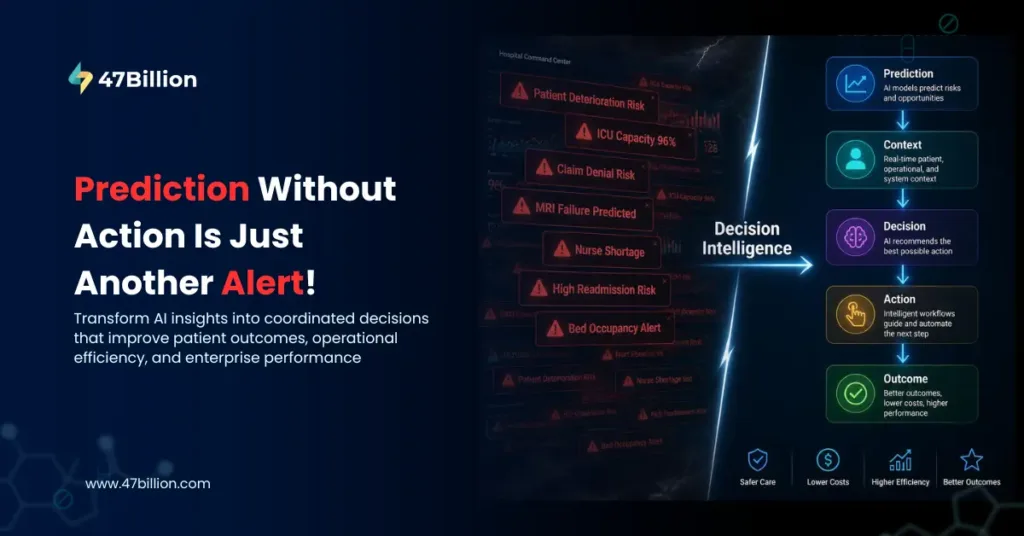
A hospital command center comes alive as dozens of AI-generated alerts begin appearing across operational dashboards.
A predictive model identifies twelve patients at high risk of clinical deterioration over the next twenty-four hours.
Another forecasts that emergency department occupancy will exceed capacity by early afternoon.
A staffing model predicts a nursing shortage in the ICU during the evening shift.
The biomedical engineering system flags abnormal vibration patterns in an MRI scanner, indicating a high probability of component failure within the next seventy-two hours.
Meanwhile, the revenue cycle platform identifies hundreds of claims likely to be denied because of incomplete documentation and coding discrepancies.
On paper, the hospital appears remarkably intelligent.
It can predict patient deterioration.
It can forecast operational bottlenecks.
It can identify financial risks.
It can anticipate equipment failures.
Yet, despite these capabilities, the morning operations meeting looks remarkably familiar.
Clinical leaders debate which patients deserve immediate attention.
Bed managers manually reprioritize admissions and discharges.
Care managers sift through long lists of high-risk patients, trying to determine where limited resources will have the greatest impact.
Revenue cycle teams review flagged claims one by one before deciding which should be corrected first.
The organization isn’t struggling because it lacks predictive models.
It is struggling because it lacks a systematic way to transform predictions into coordinated decisions.
This represents one of the most significant gaps in modern healthcare AI.
For more than a decade, healthcare organizations have invested heavily in predictive analytics. Machine learning models have become increasingly accurate at forecasting readmissions, sepsis, mortality, emergency department demand, no-shows, staffing shortages, equipment failures, and claim denials.
Prediction has become a solved problem in many domains.
Decision-making has not.
Knowing that a patient has a 92% probability of readmission does not tell a care manager whether that patient should be contacted today or tomorrow.
Knowing that an ICU will reach capacity by noon does not determine which elective procedures should be rescheduled or which patients are clinically ready for discharge.
Knowing that a claim is likely to be denied does not identify the fastest path to prevent revenue leakage.
Healthcare has become extraordinarily good at answering what might happen.
The next competitive advantage will belong to organizations capable of answering what should happen next.
That shift marks the evolution from Predictive AI to Decision Intelligence.
Why Predictive AI Alone Is No Longer Enough in Healthcare?
Artificial intelligence has fundamentally changed healthcare’s ability to anticipate future events. Across hospitals, payer organizations, life sciences companies, and public health agencies, predictive models now influence thousands of decisions every day.
Clinical AI models identify patients at risk of sepsis hours before symptoms become clinically obvious. Readmission models estimate the likelihood that patients will return within thirty days of discharge. Early warning systems continuously monitor vital signs to detect subtle physiological deterioration, while oncology models assist physicians in identifying patients most likely to respond to targeted therapies.
Operational teams have embraced predictive intelligence with equal enthusiasm. Hospitals forecast emergency department volumes to optimize staffing, predict operating room utilization to improve scheduling, and estimate inpatient census to manage bed capacity more effectively. Biomedical engineering teams leverage sensor data and machine learning to detect anomalies in critical medical equipment, enabling predictive maintenance that minimizes unexpected downtime for MRI scanners, CT systems, ventilators, and infusion pumps.
Financial operations have experienced a similar transformation. Revenue cycle teams use predictive models to identify claims likely to be denied, detect potential coding errors before submission, forecast reimbursement delays, and uncover fraudulent billing activity. Population health programs rely on risk stratification models to identify patients most likely to develop chronic disease complications or require intensive care management.
The industry has made extraordinary progress.
What once required weeks of manual analysis can now be accomplished within seconds.
Healthcare organizations have access to more predictive intelligence than ever before.
Yet executives continue asking a familiar question.
If AI can predict so much, why haven’t operational outcomes improved at the same pace?
The answer lies in a misconception that has quietly shaped enterprise AI strategies for years.
Prediction is often mistaken for decision-making.
In reality, prediction is only the first step.
The Prediction Trap: Why Predictive AI Doesn’t Drive Better Decisions?
Most AI initiatives follow a remarkably similar pattern.
An organization identifies a business problem.
Historical data is collected and cleaned.
Machine learning models are trained.
Accuracy improves.
The model is deployed into production.
A dashboard or alert is generated.
The project is declared successful.
This sequence has become the standard blueprint for enterprise AI.
Unfortunately, it is also where many AI initiatives stop.
A hospital may successfully predict which patients are at risk of readmission.
A payer may accurately identify members likely to become high-cost.
An operations team may forecast patient demand with impressive precision.
However, these predictions often create an unexpected consequence.
They produce more alerts than organizations can realistically act upon.
Care managers receive thousands of high-risk patient notifications every month, yet have the capacity to engage only a small fraction of those individuals. Learn how Care Management Intelligence helps healthcare organizations prioritize interventions based on expected clinical impact instead of risk scores alone.
Hospital command centers monitor hundreds of operational metrics simultaneously, making it increasingly difficult to distinguish routine fluctuations from issues requiring immediate intervention.
Revenue cycle teams generate long lists of claims requiring review, but limited staffing forces them to prioritize manually.
Rather than reducing complexity, predictive AI can inadvertently increase it.
Organizations become overwhelmed not by a lack of intelligence, but by an abundance of disconnected insights.
This is the prediction trap.
Prediction identifies possibilities.
It does not establish priorities.
It highlights risk.
It does not determine intervention.
It surfaces information.
It does not coordinate action.
Healthcare organizations therefore find themselves surrounded by increasingly sophisticated predictive models while continuing to rely on human judgment to determine what happens next.
Prediction, no matter how accurate, creates value only when it changes decisions.
Without operational execution, even the most advanced predictive models remain little more than intelligent reporting systems.
Transition
The evolution of healthcare AI therefore isn’t about building models with marginally higher accuracy.
It is about building systems capable of reasoning across clinical, operational, and business contexts to recommend, prioritize, and orchestrate the next best action.
That evolution has a name.
Decision Intelligence.
What Is Decision Intelligence in Healthcare?
Artificial intelligence has transformed healthcare’s ability to identify risk.
Decision Intelligence transforms healthcare’s ability to respond to it.
Although the two concepts are often discussed together, they solve fundamentally different problems.
Predictive AI answers a probabilistic question.
What is likely to happen?
Decision Intelligence answers an operational question.
Given everything we know, what is the best action to take right now?
That distinction fundamentally changes how healthcare organizations derive value from AI.
For years, enterprise AI strategies have focused on improving predictive accuracy. Data scientists have trained increasingly sophisticated models capable of identifying clinical deterioration, forecasting patient admissions, estimating reimbursement risk, predicting equipment failures, and identifying members likely to develop chronic disease complications.
These capabilities are undeniably valuable.
However, predictions exist in isolation unless they influence a decision.
A hospital may know that fifteen patients have an elevated probability of readmission.
A payer may identify twenty thousand members at high risk for diabetes progression.
A hospital command center may forecast severe emergency department congestion within four hours.
None of these insights answers the questions healthcare leaders face every day.
Which patient should be contacted first?
Which intervention has the greatest probability of changing the outcome?
Which clinician should receive the alert?
Can the organization realistically respond with its current workforce?
Should resources be redirected elsewhere because another intervention will create greater clinical or financial impact?
These decisions require far more than prediction.
They require reasoning.
Decision Intelligence Connects Prediction with Action
Decision Intelligence represents the convergence of predictive analytics, contextual reasoning, operational intelligence, workflow orchestration, and human expertise into a single decision-making framework.
This evolution aligns closely with the concept of an AI-Native Healthcare Enterprise, where intelligence is embedded into every clinical and operational workflow.
Rather than producing isolated predictions, Decision Intelligence continuously evaluates enterprise-wide information to determine the most appropriate course of action based on current circumstances.
Think of it as the difference between a weather forecast and an air traffic control system.
A weather forecast predicts the likelihood of storms.
Air traffic control decides which aircraft should change altitude, which runways should remain operational, which departures should be delayed, and how thousands of independent decisions can be coordinated safely.
Healthcare increasingly requires the latter.
Hospitals no longer need systems that simply predict demand.
They need systems capable of coordinating patient movement across emergency departments, inpatient units, operating rooms, diagnostic services, environmental services, and post-acute care providers.
Care management programs no longer need lists of high-risk members.
They need intelligence capable of identifying which intervention should occur today, who should perform it, and which patients are most likely to benefit from limited care management capacity.
Revenue cycle teams do not benefit from thousands of denial alerts.
They benefit from systems that automatically prioritize high-value claims, identify missing documentation, recommend corrective actions, and route work to the appropriate specialists before reimbursement is affected.
Decision Intelligence shifts AI from observation to execution.
Why Decision Intelligence Is More Than Better AI Models?
One of the biggest misconceptions surrounding enterprise AI is that better outcomes simply require more sophisticated machine learning models.
In reality, even highly accurate predictions often fail to create measurable organizational impact because they operate independently of the systems responsible for executing work.
Healthcare decisions rarely depend on a single prediction.
They require multiple forms of intelligence operating simultaneously.
Clinical context.
Operational constraints.
Business priorities.
Regulatory requirements.
Resource availability.
Patient preferences.
Historical outcomes.
Organizational policies.
Decision Intelligence brings these dimensions together.
Instead of asking a predictive model to solve an operational problem, organizations create an enterprise intelligence layer capable of synthesizing diverse sources of information before recommending the next best action.
Prediction becomes one input.
Not the final output.
The Five Building Blocks of Healthcare Decision Intelligence
Decision Intelligence emerges when multiple technologies operate as a coordinated enterprise capability rather than isolated AI applications.
Predictive Intelligence
Machine learning models identify future clinical, operational, and financial risks.
These models answer questions such as:
- Which patients are likely to deteriorate?
- Which MRI scanner is approaching component failure?
- Which claims are most likely to be denied?
- Which patients are likely to miss appointments?
Prediction identifies opportunities for intervention.
It does not determine the intervention itself.
Contextual Intelligence
Every prediction gains meaning only within its surrounding context.
A patient with a high readmission score may already have an upcoming specialist appointment.
Another patient with a lower score may have declining medication adherence, transportation challenges, and no scheduled follow-up care.
Although the first patient appears riskier statistically, the second may present a far greater opportunity for successful intervention.
Context changes priority.
Context changes decisions.
Operational Intelligence
Healthcare organizations operate under finite resources.
Beds.
Nurses.
Physicians.
Care managers.
Operating rooms.
Diagnostic equipment.
Decision Intelligence continuously evaluates operational constraints alongside clinical priorities to recommend actions that are both medically appropriate and operationally feasible.
The best decision is rarely the most clinically urgent in isolation.
It is the decision that creates the greatest enterprise value while preserving quality of care.
Workflow Intelligence
Healthcare outcomes depend not only on identifying the right intervention but on executing it effectively.
Workflow Intelligence understands how work moves across departments.
It recognizes dependencies between scheduling, diagnostics, pharmacy, care coordination, discharge planning, billing, and patient communication.
Instead of generating another alert, Decision Intelligence determines where work should be routed, who should perform it, when escalation is required, and how downstream activities should adapt.
The workflow becomes intelligent.
Not just the prediction.
Human Intelligence
Despite rapid advances in AI, healthcare remains fundamentally human.
Decision Intelligence is designed to augment clinicians and operational leaders, not replace them.
AI continuously analyzes information, recommends actions, explains reasoning, and automates routine coordination.
Healthcare professionals provide clinical judgment, ethical oversight, and accountability for patient care.
This human-in-the-loop model ensures that intelligence remains trustworthy, transparent, and aligned with clinical practice.
Decision Intelligence Changes the Question
Traditional healthcare AI asks:
What is the probability of an event occurring?
Decision Intelligence asks a far more valuable question:
What action creates the greatest clinical, operational, and financial impact right now?
That shift may appear subtle.
In practice, it represents one of the biggest architectural changes healthcare has experienced since the adoption of Electronic Health Records.
Because organizations no longer compete on their ability to generate predictions.
They compete on their ability to transform predictions into better decisions.
Transition
Once healthcare begins thinking in terms of decisions instead of predictions, another realization becomes clear.
No single AI model can evaluate every variable, coordinate every workflow, and execute every action across a complex healthcare enterprise.
That responsibility belongs to a network of intelligent, specialized systems working together.
This is where AI agents become the execution engine of Decision Intelligence, transforming recommendations into coordinated clinical and operational workflows across the healthcare ecosystem.
Healthcare has spent the last decade building increasingly sophisticated predictive capabilities.
Hospitals can forecast patient deterioration before symptoms become clinically obvious. Operations teams can anticipate capacity constraints before they occur. Revenue cycle platforms can identify claims at risk of denial before submission. Biomedical engineering teams can predict equipment failures before they disrupt patient care.
These capabilities represent remarkable progress.
Yet prediction alone does not create value.
Value is created when organizations can determine which action should be taken, by whom, under what circumstances, and with what expected outcome.
That is the fundamental shift now underway across healthcare.
The future of AI is not simply about generating more accurate forecasts or producing more alerts. It is about creating systems capable of continuously evaluating context, balancing competing priorities, and guiding organizations toward better decisions.
This is the promise of Decision Intelligence.
By combining predictive intelligence, contextual understanding, operational awareness, workflow coordination, and human expertise, healthcare organizations can move beyond identifying risk to actively managing it. They can transform disconnected insights into coordinated actions and convert information into measurable clinical, operational, and financial outcomes.
The organizations that lead the next decade will not necessarily be those with the most AI models.
They will be those that consistently make better decisions.
Because healthcare’s next competitive advantage will not come from knowing what might happen.
It will come from knowing what should happen next.
Looking Ahead: What’s Next: AI Agents and Decision Intelligence Part 2
Understanding the need for Decision Intelligence is only the first step.
A more important question remains:
How do healthcare organizations operationalize Decision Intelligence at enterprise scale?
No single AI model can evaluate every variable, coordinate every workflow, or execute every action across a healthcare enterprise. Turning intelligence into action requires a new architectural approach, one built around specialized AI agents that can reason, collaborate, orchestrate workflows, and continuously adapt to changing clinical and operational conditions.
In Part 2, we’ll explore:
- Why AI agents are the missing link between prediction and execution
- How agentic systems enable enterprise-wide decision orchestration
- The architecture required to support Decision Intelligence
- Real-world applications across clinical care, hospital operations, care management, revenue cycle, and predictive maintenance
- What it takes to become a truly decision-intelligent healthcare enterprise
Read Part 2: AI Agents and Decision Intelligence: Turning Predictions into Enterprise Action to discover how healthcare organizations can move from intelligent predictions to intelligent execution.
Looking to implement Decision Intelligence across your healthcare organization?
Talk to Our Healthcare AI Experts to build an enterprise AI strategy tailored to your clinical and operational goals.