Introduction: The Agent Is Not the Architecture
A hospital can deploy an AI agent that summarizes a patient’s chart.
Another can predict readmission risk.
Another can optimize bed allocation.
Another can identify claims at risk of denial.
Another can monitor medical equipment for signs of failure.
Individually, each agent may perform remarkably well.
But what happens when the patient moves from the emergency department to inpatient care?
What happens when a clinical recommendation conflicts with bed availability?
What happens when an agent needs information sitting inside a different EHR, PACS, laboratory system, claims platform, or medical device?
What happens when two agents reach different conclusions?
And who determines whether an AI-generated recommendation can actually trigger a workflow?
These are not model-performance questions.
They are architecture questions.
Healthcare is entering an era where specialized AI agents will increasingly participate in clinical, operational, financial, and administrative workflows. But deploying more agents does not automatically create a more intelligent organization. Without trusted data, shared context, enterprise knowledge, interoperability, governance, orchestration, and continuous feedback, organizations risk creating another generation of disconnected technology.
The industry has already experienced this pattern with analytics.
One dashboard for clinical quality.
Another for patient flow.
Another for revenue cycle.
Another for population health.
Another for workforce management.
Each provides valuable information. Yet the enterprise remains responsible for connecting the dots.
Agentic AI could repeat the same mistake at a much higher level of sophistication.
Instead of hundreds of disconnected dashboards, healthcare could end up with hundreds of disconnected agents.
The next challenge, therefore, is not simply building AI agents.
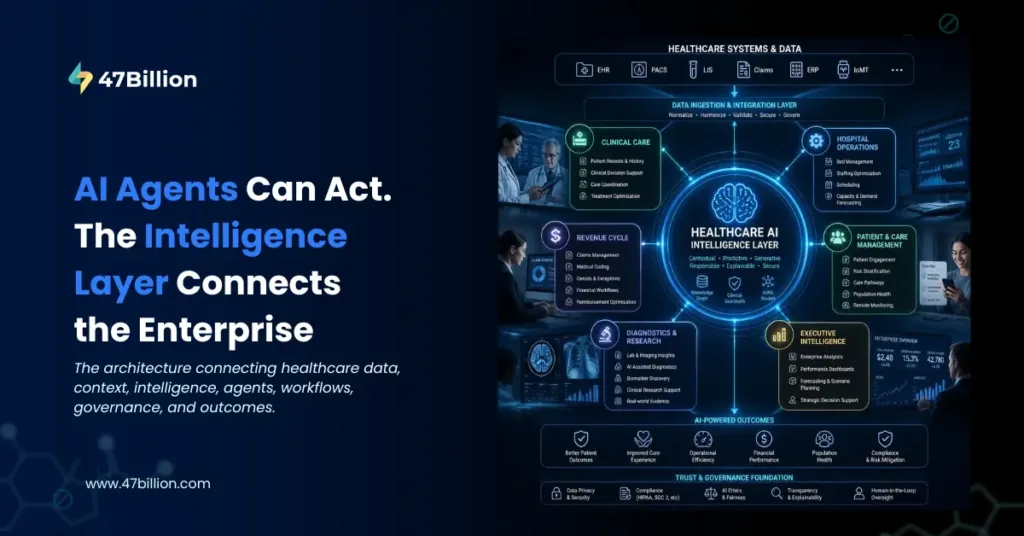
It is building the intelligence layer that allows those agents to operate as a coordinated enterprise system.
This layer connects healthcare data with context, context with reasoning, reasoning with decisions, and decisions with action.
It transforms agentic AI from a collection of intelligent tools into an enterprise capability.
And this is where the architecture behind AI becomes as important as the AI itself.
The Agent Explosion Is Coming
The healthcare industry is moving rapidly from isolated AI applications toward specialized intelligent agents.
The distinction matters.
A traditional AI model performs a defined analytical task. A predictive model estimates readmission risk. A classification model identifies an abnormal image. A language model summarizes clinical documentation.
An AI agent operates at a different level.
It can be given an objective, interpret relevant information, reason through available options, use authorized tools, interact with enterprise systems, execute defined actions, and escalate to humans when a decision exceeds its boundaries.
This makes agents particularly relevant to healthcare, where workflows are rarely confined to a single application.
Consider discharge planning.
A conventional application might generate a discharge checklist.
A predictive model might estimate the probability of delayed discharge.
An AI agent can potentially coordinate the broader workflow by reviewing clinical readiness, identifying outstanding diagnostics, checking medication reconciliation, determining post-acute requirements, coordinating follow-up appointments, communicating with care teams, and escalating unresolved dependencies.
Now imagine similar agents operating across:
- Clinical decision support
- Care coordination
- Patient engagement
- Capacity management
- Scheduling
- Revenue integrity
- Prior authorization
- Population health
- Supply chain
- Biomedical engineering
- Quality and compliance
The opportunity is enormous.
So is the architectural challenge.
As the number of agents increases, organizations must answer a new set of enterprise questions:
Who provides the agents with trusted information?
How do agents establish a shared understanding of the patient and enterprise?
How do agents access systems securely?
How do multiple agents coordinate?
How are conflicting recommendations resolved?
Which actions require human approval?
How does the organization monitor what an agent did and why?
How does the system learn from the outcome?
These questions cannot be solved by an LLM alone.
They require an enterprise healthcare AI intelligence layer.
Why an AI Agent Alone Isn’t an Enterprise AI Strategy?
The emergence of agentic AI can create the impression that healthcare organizations simply need to deploy intelligent agents on top of their existing technology stack.
That approach is unlikely to scale.
An agent without enterprise context is essentially an intelligent endpoint.
It may reason well about the information it can access, but it cannot understand what it cannot see.
An agent without interoperability cannot reliably interact with the systems where healthcare work actually happens.
An agent without governance cannot safely determine what it is permitted to do.
An agent without orchestration cannot coordinate with other agents.
An agent without memory cannot maintain meaningful longitudinal context.
An agent without observability cannot provide the auditability required for enterprise healthcare environments.
And an agent without feedback cannot continuously improve.
The distinction can be viewed as four stages:
| Capability | Role |
| AI Model | Generates a prediction, classification, or response |
| AI Agent | Reasons about a task and can take defined actions |
| Agentic System | Coordinates multiple agents and workflows |
| Enterprise Intelligence Layer | Connects data, knowledge, models, agents, workflows, governance, and outcomes |
The fourth layer is where enterprise-scale transformation occurs.
The objective is no longer to make an individual agent smarter.
It is to make the entire healthcare ecosystem intelligent.
The Healthcare AI Intelligence Layer
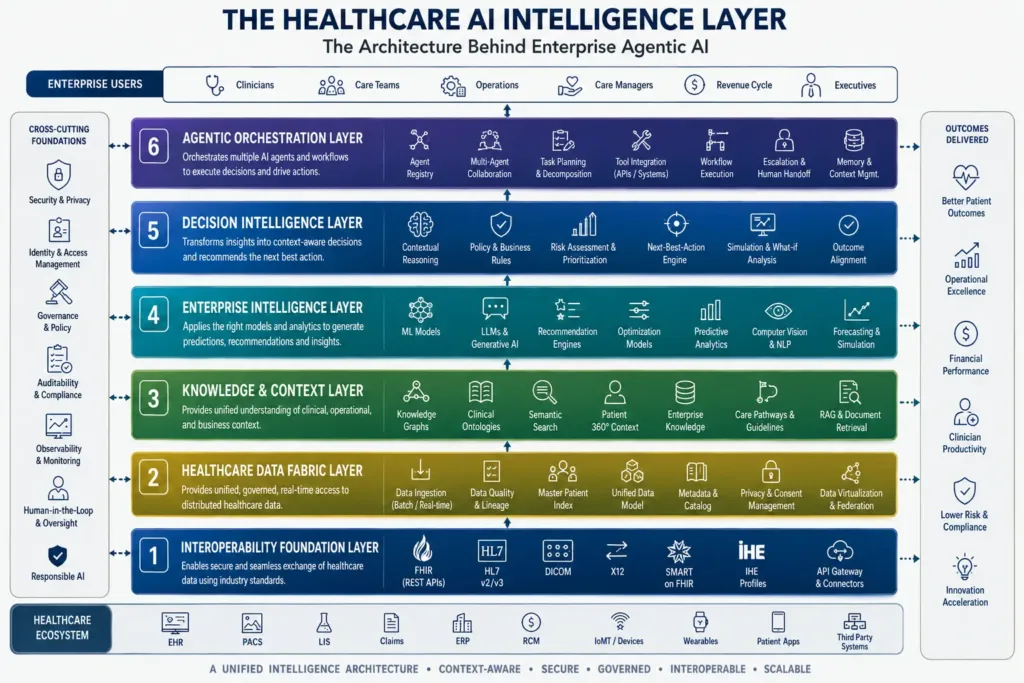
The Healthcare AI Intelligence Layer sits between the organization’s underlying technology ecosystem and the people and workflows that depend on it.
It creates a common environment in which data, knowledge, AI models, agents, and workflows can operate together.
At a conceptual level, the architecture looks like this:
Running horizontally across every layer are the capabilities that make enterprise AI trustworthy and scalable:
Security | Identity | Governance | Privacy | Auditability | Observability | Human Oversight
This is important because intelligence cannot be separated from control.
The same architecture that enables an agent to access information must also determine what information it is allowed to access.
The same architecture that enables an agent to execute an action must also determine whether that action requires human approval.
The same architecture that enables an AI system to learn must also determine whether the learning process is safe, measurable, and compliant.
This is what transforms AI from an application capability into enterprise infrastructure.
Layer 1: The Interoperability Foundation
Every intelligent healthcare system begins with access to information.
The data required to make a clinical or operational decision rarely exists in one system.
A patient’s longitudinal record may span EHR encounters, laboratory results, imaging studies, medication histories, claims, referral records, remote monitoring data, and patient-generated information.
Operational decisions require another set of systems:
Bed management.
Staffing.
Scheduling.
Supply chain.
Asset management.
Revenue cycle.
The interoperability foundation provides the connective tissue between these systems.
Standards such as HL7, FHIR, SMART on FHIR, DICOM, and X12 enable structured exchange across healthcare applications and workflows.
But interoperability should not be confused with intelligence.
FHIR can tell an AI system where a patient’s information can be accessed.
It does not automatically tell the AI system what that information means in the context of the decision it is trying to make.
Interoperability provides connectivity.
The intelligence layer builds upon that connectivity.
Layer 2: The Healthcare Data Fabric
Once information can move across systems, the next challenge is creating reliable access to it.
Healthcare data is inherently distributed.
Forcing every dataset into a single repository is often neither practical nor desirable.
A Healthcare Data Fabric creates a governed data access layer across distributed systems, enabling AI applications and agents to retrieve relevant information without requiring every source to be physically consolidated.
This layer can bring together:
- Structured clinical data
- Unstructured clinical documentation
- Medical imaging
- Claims
- Pharmacy data
- Genomics
- IoMT telemetry
- Wearables
- Patient-generated health data
- Workforce information
- Financial data
- Operational metrics
The critical requirement is not simply availability.
It is trust.
AI agents need confidence that the information they retrieve is current, authorized, appropriately governed, and sufficiently complete for the task at hand.
A data fabric therefore becomes more than an integration mechanism.
It becomes the trusted information substrate for enterprise intelligence.
Layer 3: Knowledge and Context
Data tells an AI system what exists.
Knowledge helps it understand how those things relate.
This distinction becomes especially important in healthcare.
A laboratory result cannot be interpreted independently from the patient’s condition, medication history, previous results, and current care pathway.
A diagnosis cannot be evaluated without considering the patient’s symptoms, comorbidities, treatment history, and relevant clinical guidelines.
A hospital capacity decision cannot be separated from staffing, patient acuity, predicted admissions, discharge readiness, and available resources.
This is where the Knowledge and Context Layer becomes critical.
Knowledge graphs can represent relationships between:
Patients → Conditions → Medications → Procedures → Providers → Facilities → Care Pathways → Outcomes
Clinical terminology systems such as SNOMED CT, LOINC, RxNorm, and ICD-10 can provide standardized semantic meaning.
Retrieval-Augmented Generation (RAG) can connect language models to trusted enterprise knowledge rather than relying exclusively on information encoded within a model.
Patient context engines can assemble longitudinal information around the specific decision being considered.
Together, these capabilities allow agents to move from information retrieval toward contextual reasoning.
The question changes from:
“What information do I have?”
to:
“What does this information mean for this patient, this workflow, and this decision?”
Layer 4: The Enterprise Intelligence Layer
The intelligence layer brings together multiple forms of AI rather than assuming one model can solve every healthcare problem.
Different decisions require different forms of intelligence.
Predictive models estimate future risk.
Optimization models identify the most effective allocation of constrained resources.
Large Language Models interpret and generate natural language.
Multimodal models reason across combinations of text, images, signals, and other data modalities.
Recommendation engines evaluate potential interventions.
Decision engines apply organizational policies, constraints, and priorities.
RAG systems ground generative AI in trusted enterprise knowledge.
The architecture therefore becomes model-agnostic.
The objective is not to find one model that can do everything.
It is to route the right task to the right intelligence capability.
A clinical imaging task may require a specialized vision model.
A discharge summary may benefit from an LLM.
A staffing problem may require optimization.
A readmission problem may rely on predictive ML.
An enterprise decision may require all of them.
The intelligence layer coordinates these capabilities into a coherent decision environment.
Layer 5: Decision Intelligence
The intelligence layer produces insights.
The Decision Intelligence layer determines what those insights mean for action.
Consider a patient identified as high risk for readmission.
The prediction is only one variable.
Decision Intelligence also considers:
- Clinical severity
- Recent utilization
- Medication adherence
- Follow-up availability
- Transportation
- Caregiver support
- Provider relationships
- Care management capacity
- Previous intervention effectiveness
The result is not simply a risk score.
It is a prioritized recommendation.
Who should be contacted?
When should outreach occur?
What intervention is most appropriate?
Who should perform it?
What is the expected impact?
This is the difference between predictive intelligence and decision intelligence.
The former identifies possibilities.
The latter evaluates choices.
Layer 6: Agentic Orchestration
This is where intelligence becomes operational.
Specialized AI agents receive objectives, access authorized enterprise tools, reason over available context, and execute defined workflow steps.
Consider a patient admitted with acute heart failure.
A clinical assessment agent synthesizes the patient’s longitudinal record.
A diagnostic coordination agent tracks outstanding tests.
A care coordination agent begins discharge planning.
A capacity agent evaluates bed and staffing availability.
A medication agent checks reconciliation requirements.
A revenue integrity agent evaluates documentation and coding dependencies.
These agents should not operate as independent applications.
They need a shared context and an orchestration layer that determines:
- Which agent should act
- What information it can access
- Which tools it can invoke
- What actions it can perform
- When another agent should be engaged
- When a human should intervene
- How outcomes should be recorded
The architecture therefore shifts from single-agent automation to multi-agent enterprise orchestration.
Layer 7: Governance, Security and Observability
In healthcare, autonomous capability without governance is not innovation.
It is risk.
An enterprise AI architecture must continuously answer:
Who accessed the data?
Which information influenced the recommendation?
Which model or agent generated the output?
What tools were invoked?
What action was taken?
Was human approval required?
Was the action within policy?
What happened afterward?
This requires governance to be embedded throughout the architecture.
Identity and access controls determine what agents can see and do.
Privacy controls protect sensitive health information.
Audit trails record agent activity.
Model monitoring tracks performance and drift.
Agent observability captures reasoning pathways, tool calls, failures, and escalation events.
Human-in-the-loop controls establish decision boundaries for higher-risk actions.
Responsible AI therefore cannot exist as a policy document sitting outside the technology stack.
It must become an architectural capability.
The Enterprise Decision Loop
When these layers operate together, healthcare organizations move from a linear AI workflow toward a continuous intelligence loop:
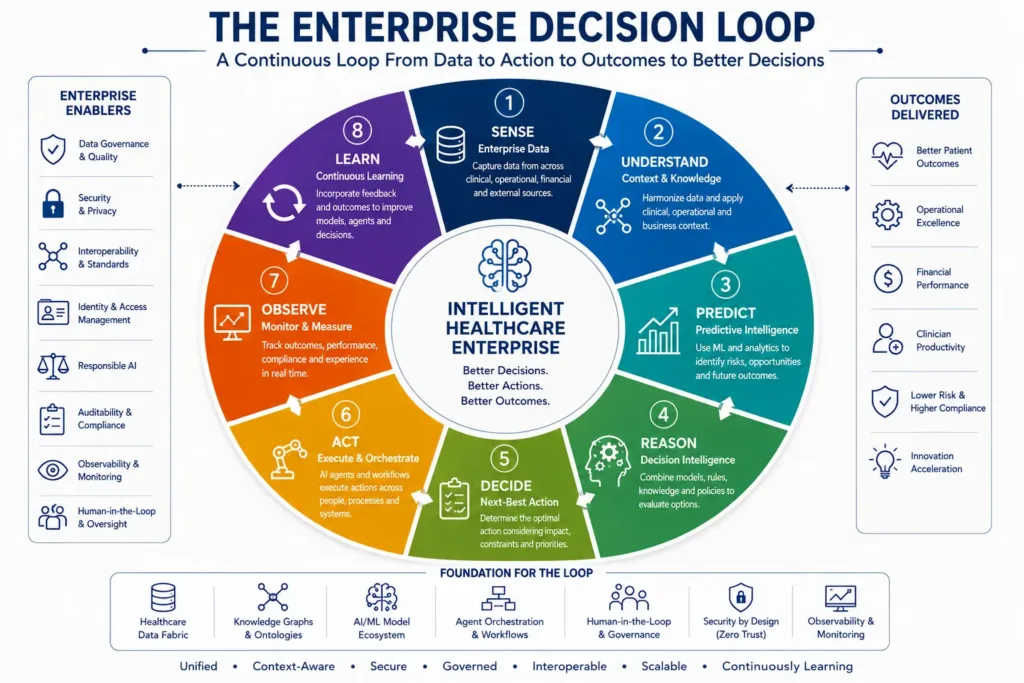
This loop is the defining characteristic of an intelligent enterprise.
The system does not stop after generating a prediction.
It observes what happened after the decision.
Did the patient recover?
Was the discharge successful?
Did the claim get paid?
Did the intervention reduce utilization?
Did the operational bottleneck disappear?
Did the maintenance intervention prevent downtime?
Those outcomes become feedback for future decisions.
The organization begins learning from its own actions.
This architectural shift changes how healthcare organizations should evaluate AI investments.
The question should no longer be:
“What AI agent should we deploy?”
Instead, leaders should ask:
“What intelligence capability does this workflow require, and what enterprise architecture will allow it to operate safely at scale?”
That means evaluating AI initiatives across five dimensions:
Data
Can the system access trusted, timely, governed information?
Context
Can it understand the clinical, operational, and organizational relationships surrounding a decision?
Intelligence
Can it select and combine the appropriate models and reasoning capabilities?
Orchestration
Can it coordinate agents, systems, people, and workflows?
Governance
Can the enterprise control, monitor, explain, and audit every meaningful action?
Without all five, organizations may achieve impressive AI demonstrations without achieving enterprise transformation.
The 47Billion Perspective
At 47Billion, we believe the next phase of healthcare AI will be defined less by individual AI applications and more by the architecture connecting intelligence across the enterprise.
The objective is not to replace the systems healthcare organizations have spent decades building.
It is to make those systems more intelligent.
That requires bringing together healthcare interoperability, data engineering, semantic intelligence, AI platform engineering, agentic systems, workflow orchestration, and responsible AI into an architecture designed around real clinical and operational outcomes.
Our perspective is straightforward:
AI agents should not become another layer of fragmentation.
They should become coordinated participants within an enterprise intelligence ecosystem.
That means designing AI systems that understand healthcare context, operate across existing technology environments, respect clinical and organizational boundaries, and translate intelligence into measurable action.
Because the future of healthcare AI will not be determined by how many agents an organization deploys.
It will be determined by how intelligently those agents work together.
Conclusion: Intelligence Needs an Architecture
Healthcare is moving beyond experimentation with artificial intelligence.
Predictive models are becoming embedded in clinical and operational workflows.
Generative AI is becoming increasingly accessible.
AI agents are beginning to perform increasingly sophisticated tasks.
But the next challenge is larger than any individual technology.
Healthcare needs an architecture capable of connecting data, knowledge, models, decisions, agents, workflows, humans, and outcomes into one continuously learning system.
That is the role of the Healthcare AI Intelligence Layer.
It provides the foundation through which enterprise AI can move from isolated intelligence to coordinated intelligence, from individual agents to collaborative agentic systems, and from recommendations to measurable outcomes.
The organizations that lead this transition will not simply have smarter AI.
They will have a smarter enterprise architecture.
And ultimately, that is what will determine whether agentic AI becomes another collection of disconnected tools or the foundation of a truly AI-native healthcare enterprise.
The future won’t be defined by how many AI agents healthcare deploys. It will be defined by how intelligently the enterprise connects them.
Ready to Build the Intelligence Layer Behind Enterprise AI?
At 47Billion, we help healthcare organizations architect and engineer the foundations required to move from AI experimentation to scalable enterprise intelligence, connecting healthcare data, interoperability, AI models, agents, workflows, and governance into systems designed for measurable impact.
Build the intelligence layer. Orchestrate the enterprise. Transform what healthcare can do with AI.