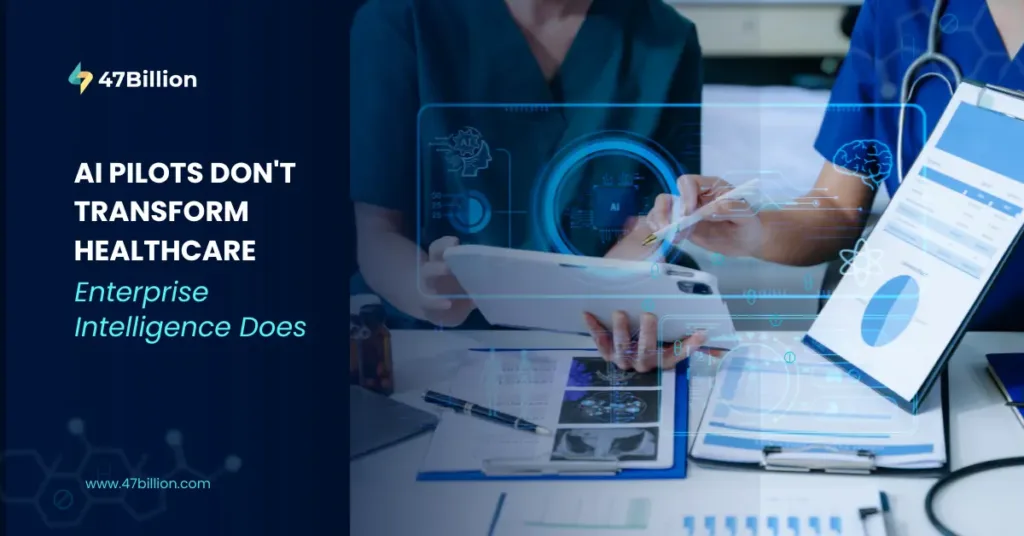
Healthcare’s AI Moment Has Arrived. Enterprise Transformation Has Not.
Healthcare has spent the last decade digitizing care delivery, operations, and patient engagement. Electronic Health Records became ubiquitous. Clinical, operational, and financial systems became increasingly connected. Data volumes exploded.
Artificial intelligence is the next phase of that journey.
Across healthcare, organizations are deploying ambient clinical documentation solutions, predictive risk models, care-management platforms, patient engagement assistants, and operational analytics systems. The question is no longer whether AI can create value. Evidence from clinical documentation, imaging, care management, and operational optimization demonstrates that it can.
The real challenge facing healthcare leaders today is different.
Most health systems do not suffer from a lack of AI innovation.
They suffer from a lack of enterprise AI architecture.
A typical healthcare organization may operate:
- An ambient documentation solution within ambulatory clinics
- A predictive deterioration model within acute care
- A revenue-cycle AI platform within finance
- A scheduling optimization solution within operations
- A patient engagement assistant within digital health
Individually, each initiative may deliver measurable results.
Collectively, however, they often create a fragmented landscape of disconnected intelligence.
Different platforms.
Different governance models.
Different data pipelines.
Different user experiences.
Different monitoring procedures.
Different security controls.
The organization possesses AI capabilities.
What it lacks is an AI operating model.
That distinction becomes critical as healthcare enters the era of Agentic AI.
Unlike traditional predictive models, agentic systems can observe, reason, plan, act, and continuously learn. They can move beyond generating recommendations to coordinating workflows, initiating actions, and interacting directly with enterprise systems.
As organizations expand from isolated AI applications to interconnected networks of intelligent agents, the central question changes dramatically:
Can the enterprise trust AI not only to generate information, but to participate in decision-making and execution?
That is the challenge of trusted agentic healthcare.
Why Agentic AI Represents a Different Class of Technology?
Most healthcare AI deployments today remain recommendation-oriented.
A predictive model identifies patients at elevated readmission risk.
A generative AI system drafts documentation for clinician review.
A decision-support model surfaces potential care gaps.
The final action still rests entirely with humans.
Agentic AI changes that equation.
Consider a patient who repeatedly misses follow-up appointments.
A traditional AI application may identify the risk and present an alert.
An agentic system could:
- Analyze attendance history
- Assess utilization risk
- Review care gaps
- Identify scheduling constraints
- Locate appointment availability
- Generate outreach content
- Initiate communication
- Schedule appointments
- Update enterprise workflows
- Escalate exceptions to care managers
At every stage, the system transitions from intelligence generation to workflow participation.
This introduces entirely new architectural and governance challenges.
The organization must determine:
- What information an agent can access
- Which systems it may interact with
- Which actions it may execute
- When human approval becomes mandatory
- How every decision is documented
- How conflicts are resolved
- How outcomes are measured
The fundamental question evolves from:
“Is the model accurate?”
to:
“Is the entire decision-to-action chain trustworthy?”
That represents a much larger enterprise challenge.
The AI Maturity Curve: Why Most Healthcare Organizations Stall
Most healthcare AI initiatives follow a predictable progression.
Stage 1: Demonstration
The organization asks:
Can AI perform the task?
A model is trained.
A proof of concept is created.
Performance appears promising.
At this stage, success is typically measured through technical metrics such as accuracy, recall, precision, or clinician acceptance.
Stage 2: Pilot
The question shifts:
Can users incorporate this capability into their workflow?
The solution enters a limited operational environment.
Clinician feedback is gathered.
Initial adoption patterns emerge.
Many projects stop here.
Stage 3: Production
The challenge changes completely.
Healthcare organizations must solve:
- Security
- Identity management
- Governance
- Availability
- Reliability
- Workflow ownership
- Regulatory compliance
- Monitoring
- Auditability
- Change management
At this point the work is no longer primarily an AI challenge.
It becomes an enterprise engineering challenge.
Stage 4: Enterprise Scale
The final stage asks:
Can intelligence operate consistently across the organization?
A single model becomes dozens.
A single workflow becomes hundreds.
A handful of users becomes thousands.
AI moves from technology initiative to operational capability.
This is where many healthcare organizations discover that architectures designed for pilots cannot support enterprise transformation.
A proof of concept demonstrates intelligence.
Enterprise architecture determines whether intelligence becomes infrastructure.
The Four Pillars of Trusted Enterprise Healthcare AI
At 47Billion, we believe sustainable healthcare AI transformation requires four interconnected capabilities.
These pillars create the foundation for trusted agentic intelligence.
Pillar 1: AI & Data Intelligence
Everything begins with data.
Healthcare information resides across:
- EHRs
- PACS repositories
- Laboratory systems
- Pharmacy platforms
- Claims systems
- CRM applications
- Workforce systems
- Medical devices
- Remote monitoring platforms
Access alone is not enough.
Organizations must transform information into usable intelligence.
This requires:
- Data engineering
- Interoperability
- Knowledge graphs
- Semantic modeling
- Machine learning
- Generative AI
- Retrieval-Augmented Generation (RAG)
- Agentic reasoning systems
The objective is not merely consolidating information.
The objective is creating a trusted intelligence layer.
Pillar 2: Digital Engineering
Many organizations underestimate this pillar.
Yet it is often where AI initiatives succeed or fail.
Enterprise AI requires:
- API ecosystems
- Event-driven architectures
- Cloud platforms
- Agent orchestration
- Microservices
- Security frameworks
- MLOps
- Observability platforms
- Identity services
A demonstration can survive manual processes.
A healthcare enterprise cannot.
Digital engineering transforms intelligence into operational capability.
Pillar 3: Product & Experience
AI adoption depends on trust.
Trust depends on transparency.
Clinicians should understand:
- What happened
- Why it happened
- Which evidence was used
- What actions were taken
- What remains pending
- Where human review is required
The most successful healthcare AI initiatives do not create more screens.
They reduce friction within existing workflows.
The highest value AI often appears almost invisible because it integrates naturally into the way people already work.
Pillar 4: Transformation & Advisory
Organizations frequently identify hundreds of possible AI use cases.
Only a handful deserve enterprise investment.
Every opportunity should be evaluated through six dimensions:
- Business impact
- Clinical impact
- Data readiness
- Technical feasibility
- Adoption likelihood
- Risk profile
The goal is not to deploy more AI.
The goal is to transform how the organization operates.
Why Healthcare Needs an Intelligence Layer?
Historically, healthcare technology evolved through applications.
EHR.
PACS.
LIS.
Revenue Cycle.
CRM.
Scheduling.
Each system solved a specific problem.
Agentic AI creates an opportunity to shift from application-centric architecture to intelligence-centric architecture.
The future healthcare stack looks like this:
Data ↓ Interoperability ↓ Knowledge ↓ Intelligence ↓ Decision Systems ↓ AI Agents ↓ Workflow Orchestration ↓ Human Oversight ↓ Enterprise Outcomes
This intelligence layer becomes the enterprise control plane through which agents coordinate actions, retrieve context, enforce policies, and align decisions.
The Future Is Not More AI. It Is an AI Operating Model.
The most important shift occurring in healthcare is not the emergence of better models.
It is the emergence of new operating models.
Traditional organizations function through:
Data → Dashboard → Human Interpretation → Action
AI-enabled organizations operate through:
Data → Prediction → Human Decision → Workflow
Agentic enterprises operate differently:
Data → Context → Intelligence → Reasoning → Decision → Agent Action → Human Oversight → Outcome → Learning
This creates a continuously improving enterprise intelligence loop.
The maturity journey is therefore not about deploying more models, more copilots, or even more agents.
It is about making intelligence a fundamental part of how the organization senses, decides, and acts.
The Next Decade Will Belong to Intelligent Enterprises
The past decade transformed healthcare into a digital industry.
The next decade will transform it into an intelligent one.
Organizations that continue treating AI as isolated applications will struggle with fragmentation, governance complexity, and limited scalability.
Organizations that invest in trusted intelligence foundations, interoperable architectures, governance frameworks, decision intelligence, and agentic orchestration will be positioned very differently.
They will stop asking:
“Where can we add AI?”
Instead, they will ask:
“Where should intelligence fundamentally change how healthcare operates?”
That is the difference between an AI deployment and enterprise transformation.
And it is ultimately the difference between experimenting with AI and building a trusted agentic healthcare enterprise.