Healthcare organizations are investing heavily in AI to improve patient experiences, support clinical decision-making, streamline operations, and reduce administrative burden. Yet many AI initiatives struggle to move beyond pilots or demonstrate sustainable business value.
The challenge is often not the AI model itself. It is the data foundation on which the AI depends.
An AI system can only reason over the information it can access, understand, and trust. When critical patient and operational data remain fragmented across disconnected systems, even the most advanced AI models operate with an incomplete view of reality.
As healthcare organizations move from experimentation to enterprise-scale AI adoption, interoperability, data quality, context, and governance are becoming just as important as the models themselves.
The Hidden Cost of Fragmented Healthcare Data
Consider a patient who visits a primary care physician for recurring fatigue. The physician reviews the electronic health record (EHR), orders laboratory tests, and updates the treatment plan.
A few weeks later, the patient visits a specialist.
The specialist may have access to portions of the patient’s history, but not necessarily the complete picture. Laboratory results might reside in one platform, medications in another, imaging reports in a third, and insurance information elsewhere.
The patient’s healthcare journey is connected.
The data supporting that journey often is not.
This becomes particularly important when AI enters the workflow.
An AI assistant may be expected to summarize a patient’s medical history, answer questions, recommend next steps, identify follow-up needs, or support clinical decision-making. However, if it cannot access relevant laboratory results, understand medication history, identify recent encounters, or establish clinical context, its outputs will inevitably be incomplete.
Healthcare does not suffer from a lack of data.
It suffers from a lack of connected, contextualized, and interoperable data.
Why Healthcare Interoperability Matters?
Interoperability is often described as the ability of systems to exchange data. In reality, it involves much more than connectivity.
Effective interoperability requires organizations to address four interconnected dimensions:
| Dimension | What It Means | Why It Matters for AI |
|---|---|---|
| Technical Interoperability | Systems can exchange information. | AI applications require dependable access to relevant data. |
| Syntactic Interoperability | Systems interpret data structures consistently. | Data must be parsed and processed reliably. |
| Semantic Interoperability | Systems preserve meaning across applications. | AI must distinguish clinically different concepts correctly. |
| Organizational Interoperability | Organizations align workflows, governance, and permissions. | Data access must support authorized and practical healthcare workflows. |
An API connection alone does not guarantee useful AI.
A laboratory result without units, reference ranges, collection times, or status information may be difficult to interpret correctly. A medication prescription does not necessarily prove that the medication is actively being taken. Information exchanged successfully can still lose meaning if context is not preserved.
For AI systems, preserving meaning is often more important than moving data.
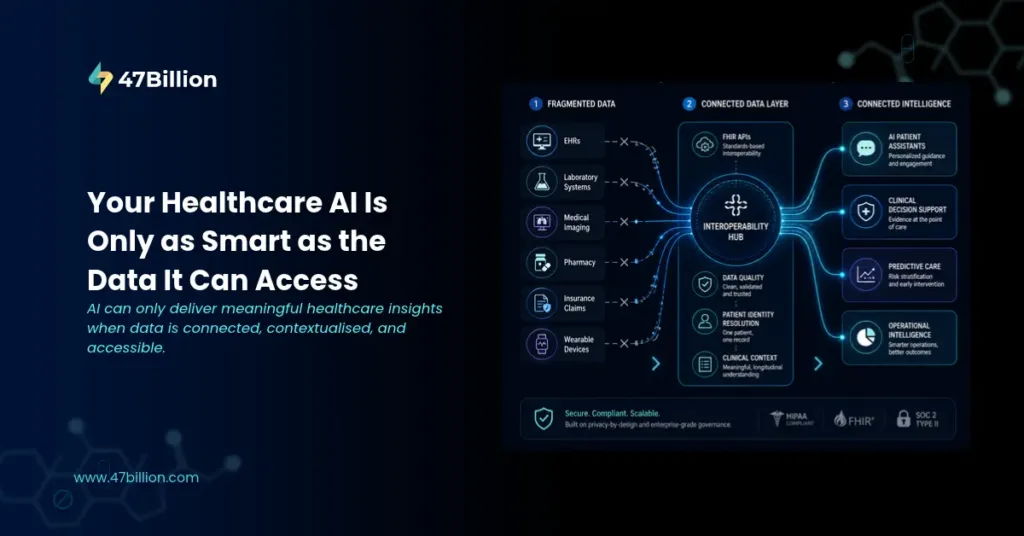
Healthcare’s Data Fragmentation Challenge
Healthcare data is generated across a complex ecosystem of providers, departments, technologies, and third-party systems.
A patient’s longitudinal health record may involve:
- Electronic Health Records (EHRs)
- Laboratory Information Systems
- Medical Imaging Platforms
- Pharmacy and Medication Systems
- Claims and Billing Applications
- Remote Monitoring Devices
- Patient Portals and Mobile Applications
- Care Coordination Solutions
Each of these systems was typically designed for a specific operational purpose.
As a result, organizations frequently encounter:
- Different data models
- Different patient identifiers
- Different terminology standards
- Different integration methods
- Different security approaches
- Different update frequencies
Even when systems are technically connected, inconsistencies can create significant problems for AI applications attempting to generate summaries, predictions, recommendations, or automated workflows.
Why More Data Doesn’t Automatically Create Better AI
Many organizations assume that accumulating more healthcare data automatically improves AI performance.
In practice, disconnected information often produces the opposite effect.
When relevant context is missing, AI-generated outputs may appear fluent and sophisticated while remaining incomplete or misleading.
Organizations frequently encounter:
Clinical and Operational Friction
Healthcare professionals spend time locating information across multiple systems instead of acting on it.
Incomplete AI Outputs
AI systems can only evaluate the information available to them. Missing data creates blind spots regardless of model sophistication.
Duplicate Workflows
Disconnected applications often result in repeated documentation, duplicate outreach efforts, and conflicting updates.
Reduced User Trust
If users repeatedly discover that AI outputs conflict with source systems, confidence in the technology declines rapidly.
Difficulty Scaling Beyond Pilots
Controlled pilot environments rarely reflect the complexity of production systems, changing records, permissions, workflows, and integrations.
The gap between a successful AI demonstration and a dependable enterprise capability is often an interoperability challenge rather than a modeling challenge.
Building AI-Ready Healthcare Data
Creating an AI-ready healthcare environment requires a structured approach that extends beyond data integration.
Organizations need a foundation capable of supporting both intelligence and action.
A mature healthcare AI architecture typically supports seven capabilities:
1. Connect
Access information from authorized systems and sources.
2. Normalize
Transform data into consistent structures and formats.
3. Reconcile
Resolve patient identity, duplicate records, and conflicting values.
4. Contextualize
Determine what information means, when it was captured, and whether it is relevant to the current task.
5. Reason
Generate summaries, insights, predictions, or recommendations using available evidence.
6. Act
Support workflows, notifications, task routing, or approved interventions.
7. Verify
Measure outcomes and confirm whether intended actions occurred successfully.
Organizations that focus exclusively on model deployment often overlook several of these foundational steps.
The Role of HL7 FHIR in Modern Healthcare AI
One of the most important standards supporting modern healthcare interoperability is HL7 FHIR (Fast Healthcare Interoperability Resources).
FHIR provides a standardized framework for representing healthcare information through reusable resources such as:
- Patient
- Encounter
- Observation
- Condition
- MedicationRequest
- MedicationStatement
- DiagnosticReport
- CarePlan
Rather than requiring every application to interpret proprietary formats, FHIR offers a common structure for healthcare data exchange.
This makes it easier for AI applications to retrieve information from multiple systems through a more consistent interface.
However, FHIR should be viewed as a foundation, not a complete solution.
A FHIR resource can still contain incomplete data, inconsistent terminology, outdated information, or references to unavailable records.
Successfully implementing AI requires organizations to establish reliable information contracts that define data quality, context, governance, and workflow requirements alongside technical standards.
Beyond Connectivity: Why Context Matters
Even when data flows successfully between systems, AI applications still need context.
Healthcare information is highly dynamic.
A medication can be prescribed, modified, discontinued, restarted, or self-reported by a patient.
A diagnosis may be active, historical, suspected, or ruled out.
A laboratory result may be preliminary or final.
AI systems must understand:
Temporal Context
When was the information created, updated, or recorded?
Provenance
Where did the information originate?
Status
Is the information current, active, corrected, discontinued, or superseded?
Completeness
Is sufficient information available to support a decision?
Authorization
Is the application permitted to access and use the information for its current purpose?
Without these dimensions, AI risks treating all information as equally valid and equally current, which can lead to poor decisions.
Four High-Value Applications of Connected Healthcare Intelligence
Patient-Facing AI Assistants
Patients increasingly expect digital self-service experiences.
However, answering a question such as:
“Do I need to prepare for tomorrow’s appointment?”
requires more than appointment data.
A useful assistant may need access to:
- Appointment schedules
- Preparation instructions
- Care plans
- Scheduling updates
- Authorized patient communications
When information is unavailable or ambiguous, the assistant must identify the gap and route the question appropriately rather than inventing an answer.
Clinical Decision Support
Clinicians often need to review:
- Recent laboratory results
- Active medications
- Diagnoses
- Allergies
- Encounter histories
- Care plans
AI can assist by organizing and summarizing information.
However, effective decision support requires trustworthy retrieval, source transparency, timestamps, and evidence visibility.
The goal is not replacing clinical judgment but improving access to relevant information.
Predictive Analytics and Care Coordination
Predictive models can identify patients who may benefit from intervention.
However, a risk score alone rarely answers critical questions:
- Has follow-up already occurred?
- Is an appointment scheduled?
- Has another provider intervened?
- What actions are currently in progress?
Connected workflows help organizations move from risk identification to meaningful action while avoiding duplicate tasks and unnecessary alerts.
Operational Intelligence
Healthcare interoperability also supports operational excellence.
Hospital decisions about bed capacity, staffing, patient flow, scheduling, diagnostics, and discharge planning often rely on information from multiple disconnected systems.
Connected operational intelligence can support:
- Capacity forecasting
- Resource optimization
- Bottleneck identification
- Staffing decisions
- Workflow coordination
Success depends not only on prediction accuracy but also on integrating insights into operational processes.
What an AI-Ready Healthcare Architecture Looks Like
Organizations increasingly require a layered architecture that separates information access, contextual understanding, AI reasoning, workflow execution, and governance.
A practical reference architecture includes:
Layer 1: Source Systems
EHRs, laboratories, imaging systems, claims platforms, devices, and patient applications.
Layer 2: Integration & Interoperability
FHIR APIs, HL7 messaging, DICOM integrations, event streams, and connectors.
Layer 3: Data Quality & Identity
Validation, terminology mapping, patient matching, conflict management, and duplicate detection.
Layer 4: Clinical Context & Knowledge
Temporal context, provenance, terminology services, rules, institutional knowledge, and retrieval frameworks.
Layer 5: AI & Decision Intelligence
Search, retrieval, summarization, prediction, recommendation, and optimization capabilities.
Layer 6: Applications & Workflow
Patient assistants, clinician tools, care coordination systems, and operational applications.
Layer 7: Governance & Observability
Access controls, monitoring, auditing, evaluation, incident management, and compliance controls.
The objective is not to add another AI tool.
It is to build connected intelligence that can operate reliably within healthcare workflows.
Governance Cannot Be an Afterthought
As healthcare organizations adopt generative AI, governance becomes increasingly important.
Organizations should maintain a clear distinction between:
- Information retrieved from source systems.
- AI-generated interpretations.
- Decisions approved by authorized personnel.
- Actions executed by applications.
- Actions confirmed by downstream systems.
- Observed outcomes.
This separation improves accountability, enables auditing, and helps organizations identify the source of failures when issues arise.
AI can contribute intelligence.
Governance ensures that intelligence is applied safely and appropriately.
What Healthcare Leaders Should Prioritize
Organizations pursuing healthcare AI should focus on five foundational capabilities:
Connectivity
Can the necessary information be accessed when needed?
Consistency
Can systems interpret information correctly and reliably?
Identity
Can data be associated with the correct patient?
Context
Can applications distinguish between current, historical, incomplete, conflicting, and missing information?
Governance
Can information and actions be managed securely, appropriately, and accountably?
These capabilities create the foundation needed for sustainable AI adoption.
The Future of Healthcare AI Is Connected Intelligence
Healthcare organizations have already invested heavily in digital infrastructure, interoperable systems, analytics platforms, and AI technologies.
The next competitive advantage will not come from deploying additional models alone.
It will come from creating an ecosystem where information can move seamlessly across systems, retain its meaning, support decisions in context, and integrate directly into real-world workflows.
Interoperability makes healthcare data accessible.
Data engineering makes it reliable.
AI transforms it into intelligence.
Governance ensures it is used responsibly.
Organizations that successfully combine these capabilities will be positioned to move beyond isolated AI experiments and build connected healthcare intelligence that improves patient experiences, supports clinicians, strengthens operations, and delivers measurable business value.
For healthcare leaders, the question is no longer whether AI can create value.
The more important question is whether the organization’s data ecosystem is prepared to support it.