Today, healthcare interoperability has reached an unprecedented level of maturity. The overwhelming majority of hospitals and physician practices now operate on certified Electronic Health Record (EHR) systems, while nationwide interoperability initiatives continue expanding healthcare’s ability to exchange information securely and at scale. The Trusted Exchange Framework and Common Agreement (TEFCA) has accelerated national health information exchange and, by 2026, facilitated the exchange of nearly 500 million health records across participating networks.
A clinician can retrieve laboratory results from another hospital in seconds. A specialist can review diagnostic images captured hundreds of miles away. Patients can access portions of their medical records through mobile applications, while wearable devices continuously stream heart rate, activity levels, glucose readings, and other physiological data into digital health platforms.
Driven by standards such as HL7, FHIR, SMART on FHIR, USCDI, and TEFCA, healthcare has made extraordinary progress in breaking down information silos and creating a connected ecosystem capable of exchanging clinical information at unprecedented speed and scale.
For more than two decades, interoperability represented healthcare’s biggest digital challenge.
Today, it represents one of healthcare’s greatest achievements.
Modern healthcare interoperability has successfully connected systems across providers, payers, laboratories, and patients, but connectivity alone is no longer enough to drive better clinical and operational decisions.
Yet many of the industry’s most persistent challenges remain.
Emergency departments continue to struggle with crowding and boarding, a challenge that has been characterized by emergency medicine leaders as a national healthcare crisis. Research consistently associates ED crowding with delays in care, increased mortality risk, staff burnout, and declining patient outcomes.
Clinicians continue facing growing administrative burden despite unprecedented access to digital tools. Research highlighted by the American Medical Association found that physicians spend more than five hours in EHR systems for every eight hours of scheduled patient care.
Revenue cycle teams continue navigating prior authorization complexity and claim denials. Recent physician surveys found that physicians process an average of 39 prior authorizations every week, consuming approximately 13 hours of clinical and administrative staff time. Nearly 90% report that prior authorization contributes to burnout.
Healthcare organizations have successfully connected their systems.
Why, then, do workflows still feel disconnected?
Because healthcare has largely treated interoperability as the destination rather than the foundation.
The industry assumed that if information could move seamlessly between systems, better decisions, improved operations, and superior outcomes would naturally follow.
In reality, information exchange was only the first step.
The Interoperability Paradox
Healthcare’s success in interoperability has exposed its next challenge.
Healthcare organizations generate one of the world’s largest and fastest-growing data ecosystems.
Clinical documentation. Laboratory data. Claims transactions. Diagnostic imaging. Genomic information. Remote patient monitoring feeds. Social determinants of health. Staffing schedules. Medical device telemetry. Patient-generated health data.
Every interaction across the care continuum creates another signal.
The industry’s response has been to build increasingly sophisticated methods for exchanging information.
Modern healthcare organizations invest heavily in:
- API ecosystems
- FHIR platforms
- Integration engines
- Health Information Exchanges
- Enterprise data platforms
- Cloud-native healthcare infrastructure
These investments have produced measurable results.
Patient information is more accessible.
Application integration is more standardized.
Healthcare innovation is faster.
FHIR has become one of the most actively developed healthcare interoperability standards and is increasingly becoming the foundation of modern healthcare software ecosystems.
Yet a critical question remains unanswered:
Has greater connectivity produced proportional improvements in decision-making?
Organizations exploring the next generation of Healthcare AI Solutions are increasingly combining interoperability with AI-driven decision intelligence to improve clinical and operational outcomes.
For many healthcare organizations, the answer is no.
Healthcare has become exceptionally good at moving information.
It has not become equally effective at transforming information into coordinated action.
Data Exchange Is Not Decision Intelligence
Healthcare organizations often use the terms connected, integrated, and interoperable interchangeably.
They are not the same.
A hospital may successfully integrate its EHR with laboratory systems, radiology platforms, pharmacy applications, payer systems, and remote monitoring devices.
Technically, the environment is interoperable.
Operationally, clinicians still spend significant time assembling fragmented information across multiple screens and systems before making decisions.
Consider a patient living with congestive heart failure.
Their EHR contains years of clinical history.
A wearable device tracks activity levels.
Remote monitoring tools transmit physiological measurements.
Pharmacy systems capture medication adherence.
Claims systems reveal historical utilization patterns.
All these systems may be fully interoperable.
Every dataset may be available through APIs.
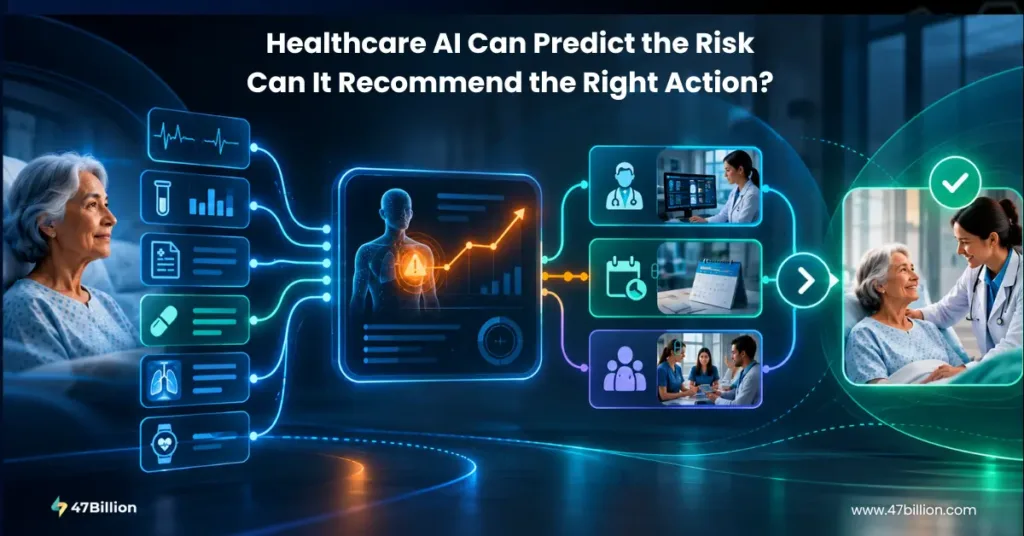
Yet none independently understands how declining activity levels, medication non-adherence, worsening vital signs, transportation barriers, previous hospitalizations, and socioeconomic circumstances combine to influence hospitalization risk.
The clinician makes that connection.
Healthcare systems exchange data.
Humans connect the dots.
Healthcare Doesn’t Have a Data Problem. It Has a Context Problem.
One of healthcare technology’s biggest misconceptions is that better decisions require more data.
Today’s challenge is rarely information scarcity.
It is information overload.
Research consistently identifies documentation burden, inbox management, alert fatigue, fragmented workflows, and EHR complexity as major contributors to physician burnout and declining professional satisfaction.
Modern healthcare generates millions of data points every day.
Yet healthcare decisions are rarely based on isolated data elements.
They emerge from relationships between multiple signals.
A slightly elevated heart rate may mean nothing independently.
Combined with declining oxygen saturation, medication non-adherence, reduced mobility, prior hospitalization history, and deteriorating social circumstances, it may indicate early clinical deterioration.
The value lies not in the data itself.
The value lies in understanding the relationships between data.
That understanding is context.
And context is what healthcare systems largely lack today.
Why Now?
Several forces are converging simultaneously to create a new opportunity for healthcare transformation.
Near-Universal Digital Adoption
Most hospitals and healthcare providers have already completed the foundational work of digitization through EHR adoption and interoperability initiatives.
National Interoperability Infrastructure
TEFCA, FHIR, USCDI, and related initiatives are creating a trusted nationwide framework for information exchange.
AI Maturity
Large Language Models, predictive analytics, knowledge graphs, machine learning platforms, and AI agents have rapidly matured from experimental technologies into enterprise capabilities.
Workforce Crisis
Healthcare faces growing workforce shortages, administrative burden, and clinician burnout, increasing the urgency of intelligent automation.
For the first time, healthcare possesses both the data foundation and the AI capabilities necessary to move beyond connectivity toward intelligence.
Introducing Healthcare Interoperability 7.0™
At 47Billion, we believe healthcare is entering its next phase of digital transformation.
The next evolution of interoperability is no longer defined by how effectively information moves between systems.
It is defined by how effectively information is interpreted, contextualized, and transformed into coordinated decisions.
We call this evolution Healthcare Interoperability 7.0™.
Healthcare Interoperability 7.0™ builds upon decades of investment in healthcare data interoperability, FHIR, HL7, and connected healthcare ecosystems to introduce an intelligence layer that enables context-aware decision-making.
Healthcare Interoperability 7.0™ is not a new messaging standard.
It is not another integration protocol.
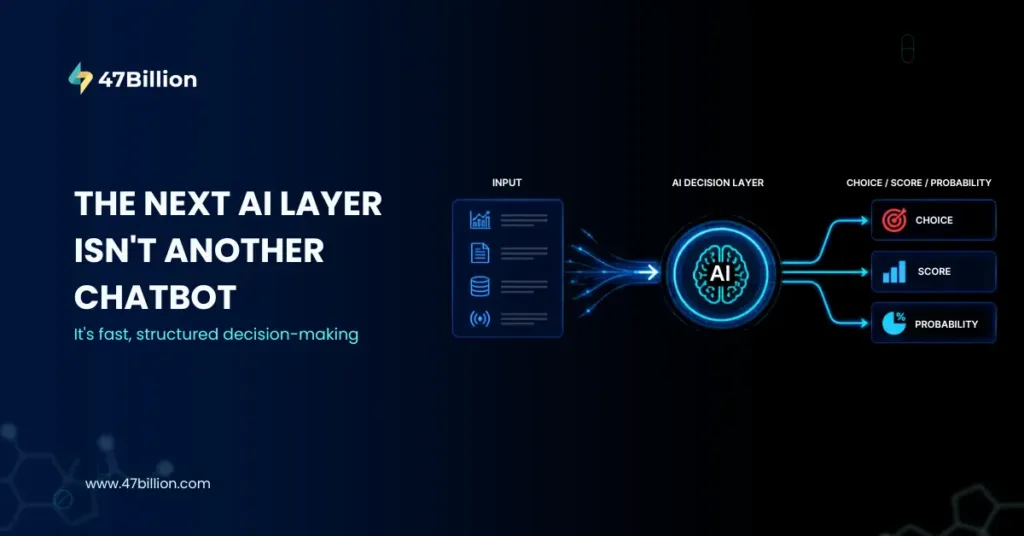
It is an architectural approach that builds on existing interoperability investments by introducing a healthcare intelligence layer capable of:
- Understanding context
- Reasoning across diverse datasets
- Coordinating workflows
- Supporting enterprise decision-making
- Orchestrating action across healthcare ecosystems
In this model:
- EHRs remain critical
- FHIR remains essential
- Interoperability remains foundational
But interoperability becomes infrastructure rather than the destination.
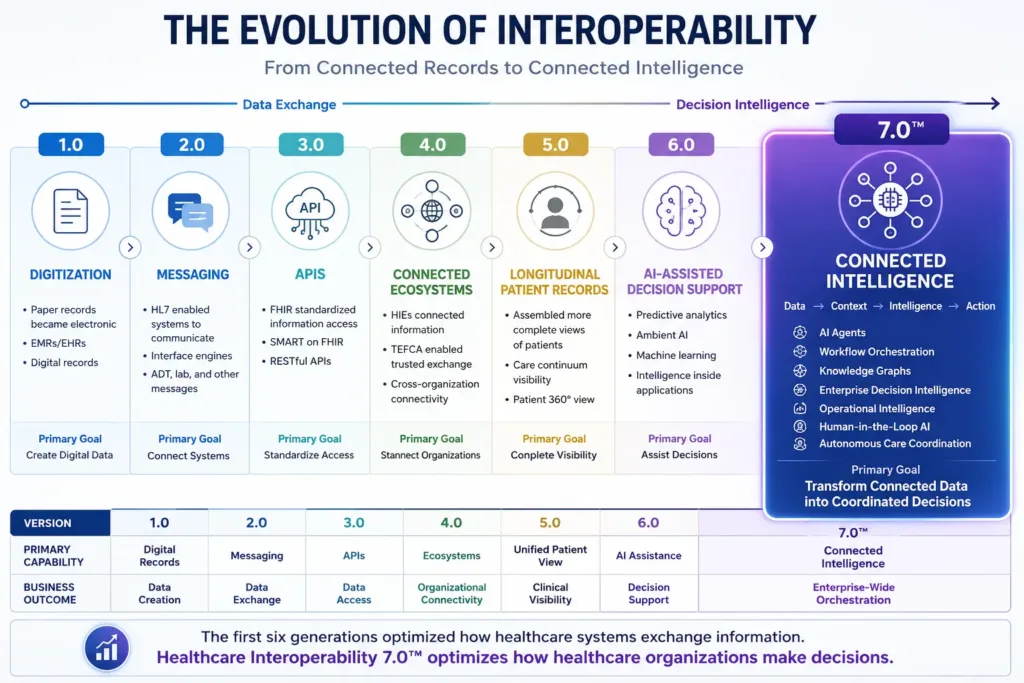
The Evolution of Interoperability
Healthcare interoperability has undergone a remarkable transformation over the past three decades, with each generation addressing the most pressing technological challenge of its time. The journey began with digitization, replacing paper records with Electronic Medical Records (EMRs) and Electronic Health Records (EHRs). As healthcare organizations adopted more digital systems, the focus shifted to messaging standards, where HL7 enabled applications to exchange clinical information across departments. The introduction of FHIR and SMART on FHIR marked the next major milestone, standardizing API-driven access to healthcare data and accelerating the development of interoperable digital health applications. This was followed by the rise of connected healthcare ecosystems, powered by Health Information Exchanges (HIEs), TEFCA, and nationwide interoperability initiatives that enabled secure data sharing across providers, payers, laboratories, and public health organizations. Healthcare then progressed toward longitudinal patient records, creating comprehensive, patient-centric views by aggregating information across the entire continuum of care. More recently, AI-assisted decision support has introduced predictive analytics, ambient AI, and machine learning into clinical workflows, helping healthcare professionals interpret information more effectively. However, despite these significant advances, every stage has primarily focused on improving how data is created, exchanged, accessed, and analyzed, while leaving enterprise decision-making and workflow coordination largely dependent on human effort. Healthcare Interoperability 7.0™ represents the next logical evolution, shifting the industry’s focus from connected data to connected intelligence, where interoperable information, AI agents, knowledge graphs, and workflow orchestration work together to transform fragmented data into coordinated, real-time clinical and operational decisions across the healthcare enterprise.
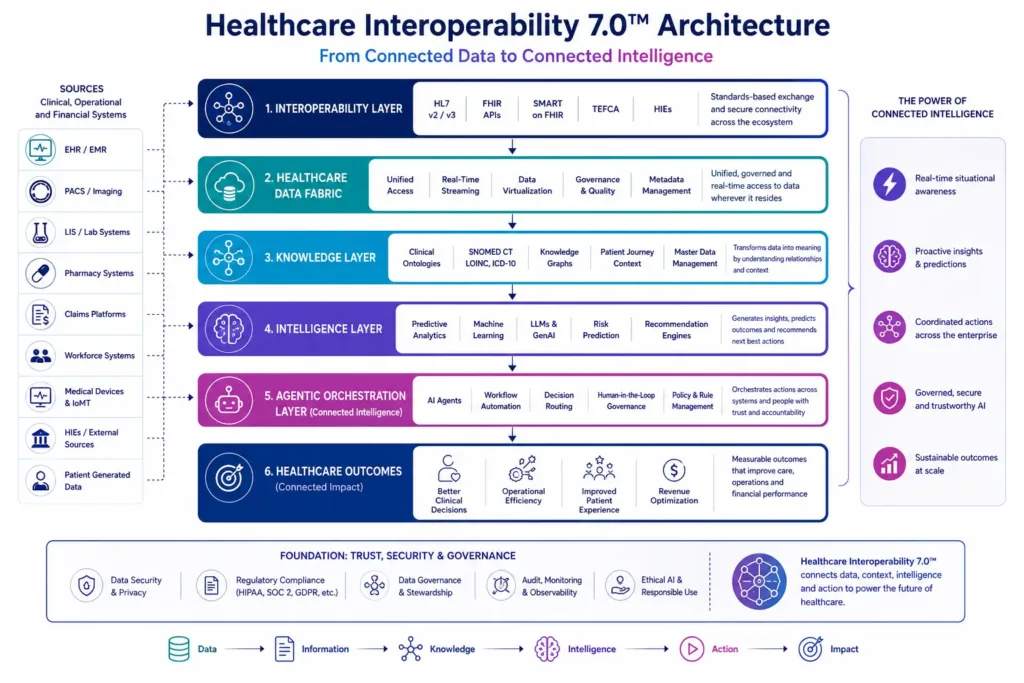
The Healthcare Interoperability 7.0™ Architecture
Healthcare organizations have spent years building digital foundations through Electronic Health Records (EHRs), interoperability standards, cloud platforms, and enterprise data ecosystems. While these investments have significantly improved data accessibility, most organizations continue to rely on fragmented workflows and human-driven coordination to transform information into decisions. The missing component is not another integration platform or data repository. It is an enterprise intelligence layer capable of understanding context, reasoning across diverse information sources, and orchestrating actions across clinical and operational workflows.
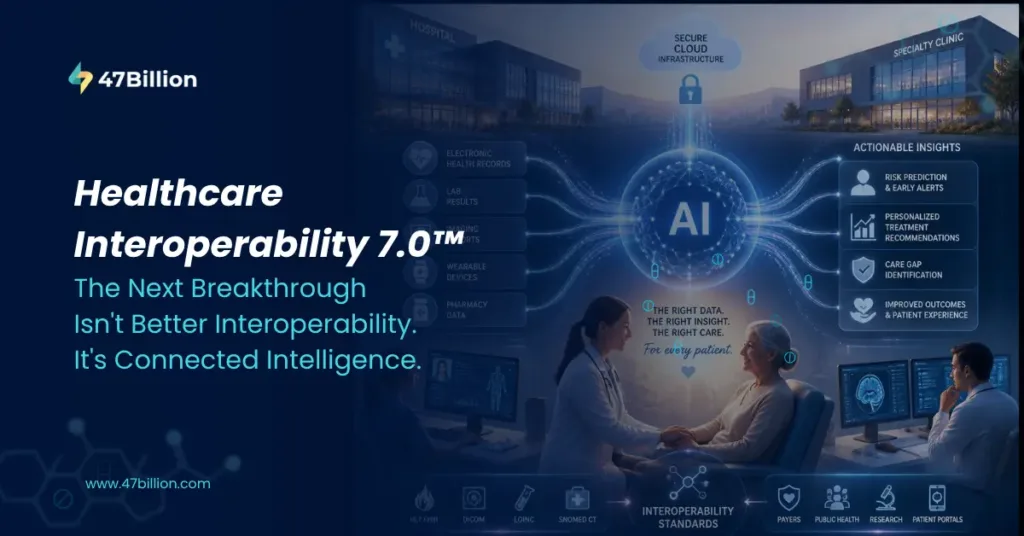
Healthcare Interoperability 7.0™ introduces this missing layer by extending the traditional interoperability stack with Connected Intelligence. Rather than treating interoperability as the final destination, the architecture positions it as the foundation for enterprise-wide decision intelligence. Existing healthcare systems such as EHRs, PACS, Laboratory Information Systems (LIS), claims platforms, workforce management systems, and connected medical devices continue generating trusted clinical and operational data. Standards including HL7, FHIR, SMART on FHIR, TEFCA, and Health Information Exchanges (HIEs) ensure this information flows securely across the healthcare ecosystem.
The real transformation begins above the interoperability layer. A Healthcare Data Fabric creates unified, governed access to distributed information in real time, while the Knowledge Layer enriches that data with clinical ontologies, knowledge graphs, standardized vocabularies, and patient journey context to establish semantic understanding across the enterprise. Building upon this contextual foundation, the Intelligence Layer combines predictive analytics, machine learning, large language models (LLMs), and recommendation engines to identify risks, surface insights, and determine the next best actions. Finally, an Agentic Orchestration Layer enables specialized AI agents to coordinate workflows across departments, automate routine processes, route decisions intelligently, and operate within governance frameworks that keep clinicians and operational leaders firmly in control.
The result is a healthcare enterprise that no longer treats data exchange as the endpoint of digital transformation. Instead, information flows seamlessly through successive layers of context, intelligence, and orchestration, enabling organizations to make faster clinical decisions, optimize operations, improve patient experiences, and strengthen financial performance. In Healthcare Interoperability 7.0™, Connected Intelligence becomes the bridge between connected data and measurable healthcare outcomes, transforming interoperability from a technical capability into a strategic enterprise advantage.
Healthcare Interoperability 7.0™ doesn’t replace your interoperability investments it amplifies them by converting connected data into connected intelligence and coordinated action across the healthcare enterprise.
From Intelligence to Action
Healthcare already generates dashboards.
Healthcare already produces alerts.
Healthcare already creates risk scores.
The problem is that insights often stop there.
Healthcare Interoperability 7.0™ introduces AI agents that move beyond analysis toward orchestration. Learn how AI Agents in Healthcare are enabling intelligent workflow orchestration across clinical and operational environments.
Imagine:
- A care coordination agent monitoring high-risk heart failure patients.
- An operations agent predicting bed bottlenecks before they occur.
- A revenue cycle agent identifying documentation gaps before claim submission.
- A supply chain agent forecasting shortages based on surgical schedules.
Individually, these capabilities create value.
Collectively, they create an AI-native healthcare enterprise.
What Healthcare Interoperability 7.0™ Looks Like in Practice?
Organizations embracing this model demonstrate five characteristics:
Clinical Intelligence
AI continuously synthesizes structured and unstructured clinical information.
Operational Intelligence
Systems predict patient flow disruptions, staffing needs, and capacity constraints.
Financial Intelligence
AI proactively identifies revenue leakage and reimbursement risks.
Population Intelligence
Organizations dynamically prioritize high-risk populations.
Enterprise Orchestration
AI agents collaborate across departments while maintaining governance and transparency.
The objective is not replacing clinicians.
The objective is reducing cognitive burden so clinicians can focus on patient care.
By the Numbers: The Interoperability Paradox
- Nearly 500 million health records exchanged via TEFCA. [hhs.gov]
- 5+ hours in EHRs for every 8 hours of scheduled patient care. [ama-assn.org]
- 39 prior authorizations handled weekly per physician on average. [beckersasc.com]
- Nearly 90% of physicians report prior authorization contributes to burnout. [beckersasc.com]
- More than 80% of appealed Medicare Advantage prior authorization denials are overturned. [beckersasc.com], [insights.wchsb.com]
- Emergency department boarding is recognized as a major national operational challenge affecting quality, cost, and patient outcomes. [acep.org], [ahrq.gov]
The 47Billion Perspective
At 47Billion, we believe interoperability is the foundation—not the finish line.
Healthcare organizations have spent years investing in connected systems, cloud infrastructure, APIs, and data platforms.
The next opportunity is transforming those investments into connected intelligence.
By combining interoperable data, AI, predictive analytics, workflow orchestration, knowledge graphs, and human-centered design, healthcare organizations can move from fragmented workflows to intelligent healthcare operations.
Healthcare Interoperability 7.0™ represents that vision.
Not another standard.
Not another integration project.
A blueprint for building intelligent healthcare enterprises.
The Future Belongs to Connected Intelligence
The last twenty years of healthcare innovation have been defined by one ambition: making information accessible.
The next twenty years will be defined by making information actionable.
Healthcare has already achieved remarkable progress in interoperability. Standards such as HL7, FHIR, SMART on FHIR, USCDI, and TEFCA have laid a robust foundation for secure and standardized data exchange. Yet, interoperability alone cannot address the growing complexity of modern healthcare delivery.
The organizations that will lead the next decade are unlikely to be those with the largest data repositories or the most integrated technology stacks.
They will be the organizations that can transform interoperable data into coordinated intelligence, enabling clinicians, administrators, and executives to make faster, more informed decisions while allowing AI to automate routine coordination across the enterprise.
In that future, interoperability is no longer measured by how successfully systems exchange information.
It is measured by how effectively healthcare organizations improve outcomes, reduce operational friction, and deliver better experiences for patients and care teams alike.
That is the vision behind Healthcare Interoperability 7.0™.
Not simply a new phase of interoperability.
A new way of thinking about connected healthcare.
Organizations investing in Enterprise AI Consulting are already building the intelligent healthcare platforms that support this next generation of connected care.
Ready to Move Beyond Data Exchange?
Healthcare organizations have spent years building connected systems. The next step is building connected intelligence.
Whether you’re modernizing interoperability, implementing enterprise AI, or reimagining clinical and operational workflows, the opportunity lies in transforming your existing digital foundation into an intelligent, adaptive healthcare ecosystem.
Partner with 47Billion to build AI-powered healthcare interoperability solutions that transform connected data into measurable clinical, operational, and financial outcomes.