AI Agents in Healthcare are transforming how healthcare organizations move from prediction to execution.
For years, healthcare AI has largely functioned as an advisory system, generating predictions and recommendations while leaving execution entirely to clinicians and operational teams.
Today, AI agents are emerging as the missing link between predictive intelligence and enterprise-wide action.
Algorithms identify patients at risk of readmission.
Machine learning models predict emergency department volumes.
Predictive analytics estimate claim denial probabilities.
Clinical AI flags patients showing early signs of sepsis.
Each model performs its task exceptionally well.
Yet after generating a prediction, the workflow usually returns to humans.
A clinician reviews the alert.
A care manager prioritizes outreach.
An operations manager reallocates beds.
A revenue cycle specialist investigates documentation gaps.
The intelligence stops where execution begins.
This is precisely where most healthcare AI initiatives lose momentum.
Prediction alone cannot coordinate the dozens of interconnected decisions required across a modern healthcare enterprise.
Decision Intelligence therefore requires something fundamentally different.
Organizations adopting Healthcare AI Solutions can embed AI agents into clinical and operational workflows to accelerate enterprise-wide decision-making.
It requires AI systems capable of acting on intelligence rather than simply producing it.
This is the role of AI agents.
AI Agents in Healthcare bridge the gap between predictive analytics and real-world execution by continuously coordinating clinical, operational, and administrative workflows.
Unlike traditional predictive models that generate isolated outputs, AI agents operate as autonomous problem-solvers with clearly defined objectives, access to enterprise data, reasoning capabilities, and the ability to interact with other systems while remaining within governance boundaries.
Rather than answering a single question, they continuously evaluate changing conditions, determine the next best action, collaborate with other agents, and coordinate workflows across departments.
In other words, predictive AI tells you what may happen.
Learn how Decision Intelligence in Healthcare transforms predictive insights into coordinated enterprise decisions in Part 1 of this series.
AI agents determine what should happen next.
Why Healthcare Is Ready for AI Agents and Agentic AI?
Healthcare is reaching an inflection point driven by several converging forces:
- Growing workforce shortages
- Rising administrative costs
- Increasing data complexity
- Mature interoperability standards
- Rapid advances in generative and agentic AI
Organizations are recognizing that simply adding more predictive models creates fragmented intelligence. The next phase of transformation requires systems capable of coordinating decisions across the enterprise rather than generating isolated insights. The rapid adoption of Agentic AI in Healthcare is enabling organizations to move beyond isolated predictions toward coordinated enterprise decision-making.
From Intelligent Models to Intelligent Teams
Healthcare organizations often think about AI as a single application.
In reality, no individual model can understand every aspect of a hospital’s operations.
Healthcare is simply too complex.
Clinical care.
Hospital operations.
Revenue cycle.
Care management.
Patient engagement.
Supply chain.
Biomedical engineering.
Compliance.
Each domain has different objectives, workflows, data sources, regulations, and decision-makers.
Attempting to solve all of these problems with one monolithic AI model creates complexity rather than intelligence.
AI-native healthcare enterprises instead deploy multiple specialized AI agents, each responsible for a specific function while collaborating as part of a coordinated enterprise ecosystem.
This approach forms the foundation of an AI-Native Healthcare Enterprise, where intelligence is embedded into every clinical and operational workflow.
Think of them as digital members of the healthcare workforce.
Each possesses deep expertise within its own domain.
Each continuously shares context with others.
Each contributes to a larger organizational objective.
Instead of isolated automation, healthcare gains coordinated intelligence.
How AI Agents Power Decision Intelligence Workflows?
Consider a patient arriving at the emergency department with symptoms of acute heart failure.
Within seconds, multiple AI agents begin working simultaneously.
Clinical Assessment Agent
Reviews the patient’s longitudinal health record, laboratory history, imaging reports, medications, allergies, recent admissions, wearable device data, and evidence-based clinical guidelines.
It generates a structured patient summary and highlights immediate clinical concerns for the physician. This capability is increasingly important for conditions such as sepsis, one of the most expensive conditions treated in U.S. hospitals. According to AHRQ, sepsis hospitalizations increased from approximately 1.8 million in 2016 to 2.5 million in 2021, with total hospital costs rising from roughly $31 billion to over $52 billion during the same period.
Capacity Management Agent
Evaluates current inpatient occupancy, ICU availability, staffing levels, expected discharges, and predicted admissions over the next several hours.
Instead of waiting for bed shortages to occur, it proactively recommends the most appropriate placement strategy.
Diagnostic Coordination Agent
Analyzes physician orders and operational capacity to prioritize laboratory testing, radiology scheduling, and specialist consultations based on patient acuity and resource availability.
Care Coordination Agent
Reviews payer requirements, previous care plans, chronic disease history, transportation availability, social determinants of health, and caregiver support.
It begins planning discharge before the patient is even admitted, reducing avoidable delays later in the care journey.
Revenue Integrity Agent
Simultaneously validates documentation completeness, predicts coding gaps, identifies prior authorization requirements, and prepares reimbursement workflows while care is still being delivered.
Predictive Maintenance Agent
While the patient undergoes diagnostic imaging, another agent continuously monitors MRI and CT scanner telemetry, evaluating cooling systems, vibration patterns, power consumption, and component health.
If a critical component shows signs of imminent failure, the system automatically schedules maintenance during the lowest-utilization window, reroutes future imaging appointments, and notifies biomedical engineering teams before patient care is disrupted.
Instead of reacting to unexpected equipment failures that delay diagnoses and surgeries, hospitals maintain continuous operational readiness through autonomous coordination.
None of these agents operates independently.
Each contributes intelligence to a shared enterprise context.
As clinical conditions evolve, operational priorities shift, or resource availability changes, every participating agent adapts accordingly.
This transforms healthcare from a collection of disconnected workflows into a continuously coordinated system.
How AI Agents Create Enterprise Decision Loops?
Traditional predictive analytics produces isolated events.
Patient at risk.
Claim at risk.
Equipment at risk.
Staff shortage predicted.
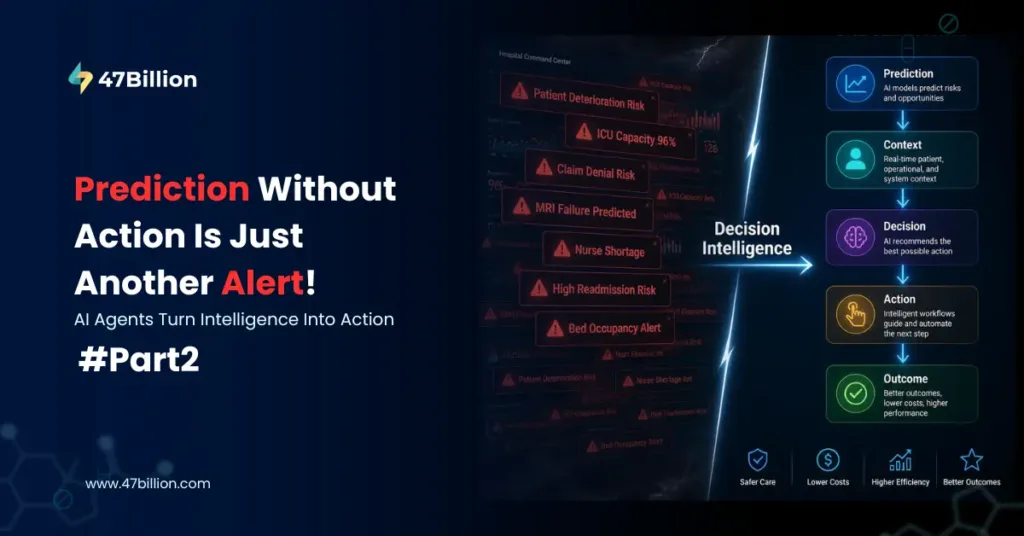
Decision Intelligence creates closed-loop workflows.
Prediction.
↓
Context evaluation.
↓
Enterprise reasoning.
↓
Workflow orchestration.
↓
Human approval where appropriate.
↓
Execution.
↓
Continuous outcome monitoring.
↓
Learning.
Every completed intervention becomes new organizational knowledge.
Every successful discharge improves future discharge recommendations.
Every resolved denial strengthens reimbursement models.
Every equipment repair enhances maintenance forecasting.
Every care management intervention improves future prioritization strategies.
The enterprise doesn’t simply automate work.
It continuously becomes smarter.
Why Agentic AI Is Transforming Enterprise Healthcare?
The emergence of Agentic AI represents a fundamental architectural shift.
Earlier generations of healthcare AI focused on prediction.
The next generation focuses on coordination.
Healthcare organizations will increasingly rely on networks of specialized AI agents capable of collaborating across departments, continuously sharing context, adapting to changing operational conditions, and supporting clinicians throughout the entire patient journey.
This does not remove humans from healthcare.
It removes unnecessary friction from healthcare.
Clinicians spend less time searching for information.
Care managers spend less time prioritizing spreadsheets.
Operations teams spend less time reacting to crises.
Revenue cycle specialists spend less time correcting preventable errors.
Instead, professionals focus their expertise where it creates the greatest value: delivering care, solving complex problems, and improving patient outcomes.
AI agents become the operational workforce that supports, coordinates, and augments human teams.
Transition
If AI agents are the execution engine of Decision Intelligence, they still require a common foundation to operate effectively.
They need trusted data.
Shared context.
Enterprise governance.
Interoperable systems.
And an architecture capable of coordinating intelligence across the organization.
That is why Decision Intelligence is not simply another AI model.
It is an enterprise architecture.
Decision Intelligence Architecture for AI Native Healthcare?
Decision Intelligence is not another predictive model, a dashboard, or a generative AI application.
A modern Healthcare AI Platform combines interoperable data, AI agents, contextual reasoning, and workflow orchestration into a unified enterprise intelligence layer.
It is an enterprise capability.
To consistently make better decisions across clinical, operational, and financial domains, healthcare organizations require an architecture that continuously transforms fragmented information into coordinated action. This architecture must not only ingest data from dozens of enterprise systems but also understand context, reason across multiple variables, orchestrate workflows, and continuously learn from outcomes.
Unlike traditional AI deployments, where models operate independently within specific applications, Decision Intelligence functions as a connected intelligence layer spanning the entire healthcare enterprise.
Each architectural component contributes a unique capability, but the true value emerges when they operate as a single, continuously learning ecosystem.
Layer 1: Enterprise Data Foundation
Every healthcare decision begins with data.
Hospitals generate enormous volumes of information across Electronic Health Records (EHRs), Laboratory Information Systems (LIS), Radiology Information Systems (RIS), Pharmacy Management Systems, Revenue Cycle Platforms, ERP systems, medical devices, wearables, remote patient monitoring solutions, and patient engagement applications.
The challenge is not collecting data.
It is making it usable.
Healthcare organizations often struggle with fragmented data distributed across hundreds of applications, each maintaining its own formats, identifiers, and update cycles.
Decision Intelligence begins by establishing a unified enterprise data foundation through interoperability standards such as HL7, FHIR, SMART on FHIR, DICOM, X12, and TEFCA.
Instead of replacing existing systems, these standards enable trusted information exchange across the healthcare ecosystem.
Interoperability provides access.
Decision Intelligence builds upon that access.
Layer 2: Healthcare Data Fabric
Interoperability alone cannot eliminate enterprise fragmentation.
Clinical records remain distributed.
Claims information resides in payer platforms.
Medical devices generate continuous telemetry.
Operational systems maintain staffing schedules, asset inventories, and capacity information.
A Healthcare Data Fabric creates a logical layer that unifies these distributed sources into a single enterprise view without physically consolidating every dataset.
Rather than repeatedly copying information into centralized repositories, the data fabric enables secure, governed, real-time access to information wherever it resides.
This dramatically improves data freshness while reducing duplication, latency, and governance complexity.
More importantly, it provides every downstream AI capability with consistent, enterprise-wide context.
Layer 3: Knowledge and Context Layer
Healthcare decisions depend on relationships rather than isolated facts.
A laboratory value gains meaning only when interpreted alongside medications, diagnoses, previous admissions, imaging studies, physician notes, genomic markers, social determinants of health, and evidence-based clinical guidelines.
This contextual understanding is impossible using traditional relational databases alone.
Healthcare organizations therefore require semantic intelligence.
Knowledge graphs become a foundational component of Decision Intelligence by representing relationships between patients, providers, diagnoses, medications, procedures, facilities, devices, workflows, and organizational policies.
Clinical ontologies such as SNOMED CT, LOINC, RxNorm, and ICD-10 further enrich enterprise information, allowing AI systems to reason using standardized clinical concepts instead of isolated data elements.
Instead of answering:
“What is this patient’s latest potassium level?”
The system understands:
“How does this laboratory trend, combined with medication changes, heart failure history, declining renal function, and recent emergency department visits influence the patient’s likelihood of clinical deterioration?”
This represents the transition from data retrieval to clinical reasoning.
Layer 4: Intelligence Layer
Once enterprise data has been unified and contextualized, it becomes available to multiple AI capabilities operating simultaneously.
This layer combines several complementary technologies rather than relying on a single model.
Predictive analytics forecast future clinical and operational events.
Machine learning continuously improves prediction accuracy using real-world outcomes.
Large Language Models (LLMs) synthesize unstructured clinical documentation, physician notes, discharge summaries, and policy documents.
Retrieval-Augmented Generation (RAG) grounds LLM responses in trusted enterprise knowledge, reducing hallucinations and ensuring recommendations remain aligned with organizational policies and clinical evidence.
Recommendation engines evaluate multiple intervention strategies based on patient characteristics, operational constraints, historical outcomes, and enterprise priorities.
Rather than generating isolated predictions, this intelligence layer continuously produces evidence-based recommendations that reflect the organization’s current clinical and operational reality.
Layer 5: Decision Intelligence Engine
This is the architectural component that distinguishes Decision Intelligence from traditional predictive analytics.
The Decision Intelligence Engine evaluates multiple dimensions simultaneously before determining the next best action.
Clinical urgency.
Patient preferences.
Resource availability.
Operational constraints.
Regulatory requirements.
Financial implications.
Organizational priorities.
Historical intervention outcomes.
Instead of asking whether a patient is high risk, the engine determines whether intervention today will produce greater value than intervention tomorrow.
Instead of recommending another alert, it evaluates competing priorities across hundreds of simultaneous decisions and ranks actions according to expected enterprise impact.
Healthcare decisions become dynamic rather than static.
Context continuously influences prioritization.
Layer 6: Agentic Orchestration
Recommendations alone do not improve healthcare.
Execution does.
Specialized AI agents translate enterprise recommendations into coordinated workflows.
A Clinical Decision Agent supports physicians during diagnosis and treatment planning.
A Care Coordination Agent organizes follow-up appointments, community resources, and chronic disease interventions.
A Capacity Management Agent continuously balances admissions, discharges, staffing, and bed allocation.
A Revenue Integrity Agent validates documentation, predicts denials, and initiates corrective actions.
A Predictive Maintenance Agent monitors connected medical equipment, forecasting failures before they disrupt patient care.
Rather than functioning independently, these agents collaborate through a shared enterprise context, exchanging information continuously while respecting governance policies and human approval requirements.
Decision Intelligence becomes operational.
Layer 7: Human-in-the-Loop Governance
Healthcare decisions carry profound clinical, ethical, and regulatory implications.
For this reason, Decision Intelligence is designed to augment human expertise rather than replace it.
Clinicians retain authority over diagnosis and treatment.
Operational leaders approve major workflow changes.
Revenue specialists validate complex financial decisions.
AI provides recommendations, supporting evidence, confidence scores, and transparent reasoning while maintaining comprehensive audit trails for every recommendation and action.
Human oversight is not a limitation of Decision Intelligence.
It is one of its greatest strengths.
Trust becomes a core architectural capability.
The Continuous Decision Loop
Traditional predictive analytics follows a linear process.
Data → Prediction → Alert
Decision Intelligence creates a continuous enterprise learning loop.
Enterprise Data ↓Healthcare Data Fabric ↓Knowledge Graph & Context ↓Predictive AI + LLMs + ML Models ↓Decision Intelligence Engine ↓AI Agents & Workflow Orchestration ↓Human Review & Execution ↓Clinical, Operational & Financial Outcomes ↓Continuous Learning & Model Improvement↺
Every intervention generates new organizational knowledge.
Every successful discharge strengthens future discharge recommendations.
Every denied claim improves financial decision models.
Every equipment repair enhances predictive maintenance algorithms.
Every patient outcome refines clinical reasoning.
The enterprise continuously learns from itself.
From Enterprise AI to Enterprise Intelligence
This architecture represents a fundamental shift in how healthcare organizations think about AI.
The objective is no longer to build isolated predictive models or deploy generative AI within individual applications.
The objective is to engineer an enterprise capable of continuously sensing, reasoning, deciding, acting, and learning across every clinical and operational workflow.
Organizations that embrace this architecture move beyond AI experimentation toward AI-native decision-making, where intelligence becomes embedded into the operating model rather than existing as a standalone technology initiative.
Transition
Technology alone, however, does not create transformation.
The true measure of Decision Intelligence lies in the outcomes it enables.
How AI Agents Enable Decision Intelligence Across Healthcare?
Decision Intelligence is not another clinical decision support tool.
Nor is it confined to predictive analytics.
Its real value lies in its ability to coordinate decisions across an entire healthcare ecosystem, where every clinical, operational, and financial workflow influences the next.
A patient admission affects bed availability.
Bed availability influences emergency department throughput.
Emergency department congestion impacts ambulance diversion.
Delayed diagnostics postpone discharge.
Delayed discharge reduces capacity.
Reduced capacity increases elective surgery cancellations.
Healthcare operates as a highly interconnected system where thousands of micro-decisions collectively determine patient outcomes, operational efficiency, and financial performance.
Decision Intelligence recognizes these dependencies and continuously optimizes them.
Clinical Decision Intelligence
Clinical care has always depended on informed judgment.
However, the volume of information available to clinicians has grown beyond what any individual can realistically process.
A physician treating a patient with multiple chronic conditions may need to review years of clinical history, laboratory trends, imaging studies, medications, allergies, genomic markers, wearable device data, previous admissions, specialist consultations, and evolving treatment guidelines before making a decision.
Traditional AI assists by highlighting abnormalities or predicting deterioration.
Decision Intelligence goes significantly further.
Instead of producing isolated alerts, it synthesizes longitudinal patient context and recommends the next best clinical action based on enterprise knowledge, evidence-based guidelines, and real-time operational constraints.
For example, rather than simply identifying that a patient has an elevated sepsis risk, the system evaluates:
- Recent laboratory trends
- Medication history
- Existing antimicrobial therapy
- ICU capacity
- Specialist availability
- Previous treatment outcomes for similar patients
- Hospital-specific clinical protocols
It then recommends an intervention pathway, explains the reasoning, identifies supporting evidence, and coordinates downstream activities if approved by the clinician.
Clinical decision-making becomes faster, more contextual, and more consistent while preserving physician autonomy.
Operational Decision Intelligence
Hospital operations generate thousands of decisions every hour.
Admissions.
Discharges.
Transfers.
Bed allocation.
Operating room scheduling.
Staff deployment.
Diagnostic prioritization.
Environmental services.
Equipment utilization.
Historically, these decisions have relied on fragmented dashboards and manual coordination between departments.
Decision Intelligence transforms hospital operations into a continuously optimized system.
Imagine an emergency department experiencing an unexpected surge in patient arrivals.
Rather than waiting for overcrowding to occur, the Decision Intelligence platform evaluates inpatient discharge readiness, predicts upcoming admissions, assesses staffing capacity, monitors diagnostic turnaround times, and identifies available beds across the enterprise.
AI agents then recommend specific operational actions:
- Accelerate discharge for clinically appropriate patients.
- Redirect imaging requests to underutilized facilities.
- Adjust staffing assignments.
- Prioritize housekeeping resources.
- Optimize patient transfers.
Instead of reacting to bottlenecks, hospitals prevent them.
Operations become predictive rather than reactive.
Care Management Decision Intelligence
Perhaps nowhere is Decision Intelligence more valuable than in care management.
Most healthcare organizations can already identify high-risk patients.
The challenge is that care managers rarely have sufficient capacity to engage every patient requiring intervention.
A payer may identify:
- 80,000 high-risk members.
- 20,000 rising-risk members.
- Thousands of patients with medication adherence issues.
- Hundreds requiring post-discharge follow-up.
The question is no longer:
Who is high risk?
It becomes:
Which intervention will produce the greatest clinical and financial impact today?
Decision Intelligence continuously evaluates:
- Clinical severity
- Engagement likelihood
- Social determinants of health
- Previous intervention success
- Available care management capacity
- Provider relationships
- Payer objectives
Rather than producing another prioritized list, it dynamically recommends which patients should receive outreach, what type of intervention is most appropriate, which care manager is best suited, and the expected outcome of each engagement.
Care management shifts from risk identification to intervention optimization.
Revenue Cycle Decision Intelligence
Revenue cycle operations represent one of healthcare’s most data-intensive environments.
Clinical documentation.
Coding.
Prior authorizations.
Claims submission.
Denial management.
Payment reconciliation.
Appeals.
Traditional predictive analytics identifies claims likely to be denied.
Decision Intelligence focuses on preventing denials altogether.
As clinical documentation is created, AI continuously evaluates coding completeness, payer policies, authorization requirements, contract terms, and historical denial patterns.
Instead of generating alerts after submission, the system recommends corrective actions before claims enter the reimbursement process.
Revenue integrity becomes proactive rather than reactive.
Financial performance improves without increasing administrative burden.
Predictive Maintenance Becomes Operational Intelligence
Medical equipment represents one of the largest capital investments for healthcare organizations.
MRI systems, CT scanners, infusion pumps, ventilators, robotic surgical platforms, laboratory analyzers, and patient monitoring devices must remain continuously available.
Traditional maintenance strategies follow fixed schedules or respond after equipment failures occur.
Decision Intelligence transforms maintenance into an enterprise optimization problem.
AI continuously analyzes:
- Equipment telemetry
- Temperature
- Vibration
- Power consumption
- Utilization patterns
- Error logs
- Maintenance history
- Clinical schedules
When deterioration is detected, the system does not simply predict failure.
It determines:
- When maintenance should occur.
- Which technician should perform it.
- Whether procedures should be rescheduled.
- How patient flow will be affected.
- Which alternative equipment should be allocated.
The objective extends beyond preventing equipment failure.
It becomes maintaining uninterrupted clinical operations.
Executive Decision Intelligence
Healthcare executives face increasingly complex decisions that extend beyond individual departments.
How should investments be allocated?
Which service lines should expand?
How will staffing shortages affect financial performance?
Which facilities require operational redesign?
Traditional business intelligence answers these questions retrospectively.
Decision Intelligence introduces prospective enterprise planning.
Executives receive continuously updated recommendations based on clinical demand forecasts, financial performance, workforce trends, patient outcomes, reimbursement models, and regional population health indicators.
Strategic planning becomes dynamic.
Organizations move from reporting what happened to continuously shaping what happens next.
Decision Intelligence Creates a Connected Enterprise
Although these use cases appear distinct, they share a common characteristic.
Every decision improves another.
Clinical interventions influence operational capacity.
Operational efficiency affects financial performance.
Financial sustainability enables better patient care.
Patient outcomes strengthen population health strategies.
Decision Intelligence connects these previously isolated domains into a continuously learning enterprise.
Instead of optimizing individual departments, healthcare organizations optimize the entire system.
That represents the true evolution of enterprise healthcare AI.
The Future Isn’t More AI Models. It’s Better Decisions.
Healthcare has entered an era where predictive models are becoming increasingly commoditized.
Most leading health systems can forecast admissions.
Most EHR platforms offer clinical prediction models.
Most revenue cycle platforms leverage machine learning.
Competitive advantage will no longer come from prediction alone.
It will come from an organization’s ability to transform predictions into coordinated decisions that improve patient outcomes, optimize operations, reduce costs, and strengthen enterprise resilience.
Decision Intelligence is the operating model that makes this possible.
Healthcare’s next chapter will not be defined by organizations deploying more AI.
It will be defined by organizations embedding intelligence into every decision they make.
The future belongs not to predictive enterprises, but to decision-intelligent enterprises.
That is the evolution healthcare has been waiting for.
From Predictive Enterprises to Decision-Intelligent Enterprises
Healthcare has spent the better part of the last decade building predictive capabilities.
Hospitals invested in machine learning models that forecast patient deterioration, emergency department demand, equipment failures, staffing shortages, and financial risk. Payers built increasingly sophisticated risk adjustment platforms and predictive analytics engines to identify members most likely to require intervention. Providers embraced AI-powered clinical decision support, while health systems modernized their digital infrastructure through cloud migration, interoperability, and enterprise analytics.
These investments were necessary.
They established the digital foundation upon which modern healthcare operates.
However, they also revealed a new reality.
Prediction alone does not transform healthcare.
Organizations rarely fail because they lack visibility into future risks.
They fail because translating those insights into coordinated action remains overwhelmingly dependent on manual processes, fragmented workflows, and disconnected decision-making.
Healthcare has reached a point where the limiting factor is no longer data.
It is decision velocity.
The organizations that consistently outperform their peers over the next decade will not necessarily possess the most sophisticated AI models.
They will possess the most intelligent decision systems.
Decision Intelligence Is the New Competitive Advantage
Across every industry, artificial intelligence is rapidly becoming accessible.
Predictive models can be purchased.
Foundation models are widely available.
Generative AI capabilities are increasingly commoditized.
Competitive differentiation will no longer come from owning AI.
It will come from operationalizing AI.
Healthcare organizations that continue deploying isolated predictive models will generate more alerts, more dashboards, and more recommendations.
Organizations that embrace Decision Intelligence will generate better outcomes.
Because they will make faster decisions.
More consistent decisions.
More explainable decisions.
More coordinated decisions.
And ultimately, better business decisions.
The competitive advantage shifts from algorithm accuracy to enterprise execution.
That represents one of the most significant architectural changes healthcare has experienced since the widespread adoption of Electronic Health Records.
Decision Intelligence Requires a Different Mindset
For years, healthcare organizations have measured AI maturity by the number of models deployed.
How many predictive algorithms exist?
How accurate are they?
How many dashboards have been implemented?
Decision-Intelligent organizations ask fundamentally different questions.
- How quickly can we move from prediction to intervention?
- Which recommendation creates the greatest clinical and financial impact?
- How effectively do our systems coordinate across departments?
- How much cognitive burden have we removed from clinicians?
- How many operational decisions can be continuously optimized rather than manually managed?
- How effectively does every outcome improve future decision-making?
These organizations recognize that AI is no longer a technology initiative.
It is an operating model.
The conversation shifts from building AI to building intelligent enterprises.
The 47Billion Perspective
At 47Billion, we believe healthcare’s next transformation will not be driven by another predictive model or another standalone AI application.
It will be driven by Decision Intelligence.
That means engineering healthcare systems where interoperable data, contextual understanding, predictive analytics, AI agents, workflow orchestration, and human expertise operate together as a single enterprise capability.
This philosophy shapes how we design AI solutions for healthcare organizations.
Rather than treating AI as an isolated layer added to existing systems, we help healthcare enterprises embed intelligence into the workflows that define clinical care, hospital operations, population health, revenue cycle management, and patient engagement.
Our approach combines:
- Human-centered AI, ensuring technology augments clinicians rather than replacing them.
- Enterprise AI Platform Engineering, enabling organizations to scale AI securely across the enterprise.
- Healthcare Interoperability and Data Engineering, creating trusted foundations for intelligent decision-making.
- Agentic AI and Workflow Orchestration, connecting insights directly to operational execution.
- Responsible AI Governance, ensuring transparency, explainability, compliance, and trust.
Because successful healthcare AI is not measured by the sophistication of its algorithms.
It is measured by the quality of the decisions it enables.
The healthcare industry is entering a new phase of AI maturity.
The first generation focused on digitizing records.
The second connected healthcare systems.
The third introduced predictive analytics into clinical and operational workflows.
The next generation will be defined by Decision Intelligence, where AI moves beyond forecasting events to orchestrating actions across the healthcare enterprise.
This evolution changes the role of artificial intelligence itself.
AI no longer functions as a passive advisor waiting for humans to interpret recommendations.
It becomes an active participant in enterprise decision-making, continuously synthesizing context, coordinating workflows, supporting clinicians, and enabling organizations to respond intelligently to changing conditions.
Healthcare’s greatest challenge is no longer understanding what might happen.
It is deciding what to do next.
The organizations that master this capability will improve more than operational efficiency.
They will deliver safer care, accelerate clinical decision-making, optimize finite resources, strengthen financial performance, and build healthcare systems that continuously learn from every patient, every workflow, and every outcome.
The future of Healthcare AI will not be defined by better predictions—it will be defined by AI Agents in Healthcare that enable intelligent enterprise decision-making.
It will be defined by better decisions.
And that is the evolution from Predictive AI to Decision Intelligence.
Ready to Move Beyond Prediction?
Ready to implement AI agents across your healthcare organization?
Talk to Our Healthcare AI Experts to design a scalable Decision Intelligence strategy.
Predictive models can identify risk. Decision Intelligence creates impact.
At 47Billion, we partner with healthcare organizations to design and engineer AI-native platforms that combine predictive analytics, enterprise data, AI agents, and workflow orchestration to transform insights into measurable clinical, operational, and financial outcomes.
Let’s build healthcare systems that don’t just predict the future, but intelligently shape it.