Healthcare systems globally are hitting a structural limit.
Hospitals today are not just care delivery centers – they are complex, high-velocity operational systems managing thousands of interdependent workflows every day. Yet most are still run on coordination models designed decades ago.
The Operational Reality Hospitals Face Today
Healthcare executives are under increasing pressure to simultaneously improve quality, access, and financial performance:
- Bed occupancy rates in large hospitals regularly exceed 85–95%, leaving little buffer for demand spikes
- Emergency department (ED) boarding times can exceed 4–12 hours, significantly impacting outcomes and patient experience
- Operating rooms (ORs) – one of the most expensive assets – often run at only 70–80% effective utilization due to scheduling inefficiencies
- Nursing shortages are projected to reach millions globally by 2030, driving burnout and turnover
- Hospital margins remain thin, often in the 1–3% range, making inefficiency financially unsustainable
At the same time, leadership is expected to:
- Increase throughput without expanding capacity
- Reduce length of stay (LOS) while maintaining outcomes
- Improve staff productivity without increasing burnout
- Ensure real-time compliance, reporting, and quality tracking
- Coordinate care seamlessly across multi-site networks
The Core Problem: Fragmented Decision-Making
Despite massive investments in digital systems, most hospitals still operate with fragmented decision layers.
Critical decisions – such as bed assignment, discharge prioritization, OR sequencing, and staffing adjustments – are still driven by:
- Static dashboards
- Phone calls and manual escalation
- Department-level heuristics
- Retrospective reporting
This creates systemic inefficiencies:
- Delayed decisions – slower patient flow and longer LOS
- Reactive operations – inability to anticipate bottlenecks
- Cognitive overload – clinicians spending significant time coordinating instead of caring
- Revenue leakage – delayed discharges, cancelled procedures, and underutilized assets
The issue is not lack of data – hospitals generate massive volumes of it.
The issue is the absence of a real-time, system-wide decision layer.
What Is an AI-Powered Hospital Command Center?
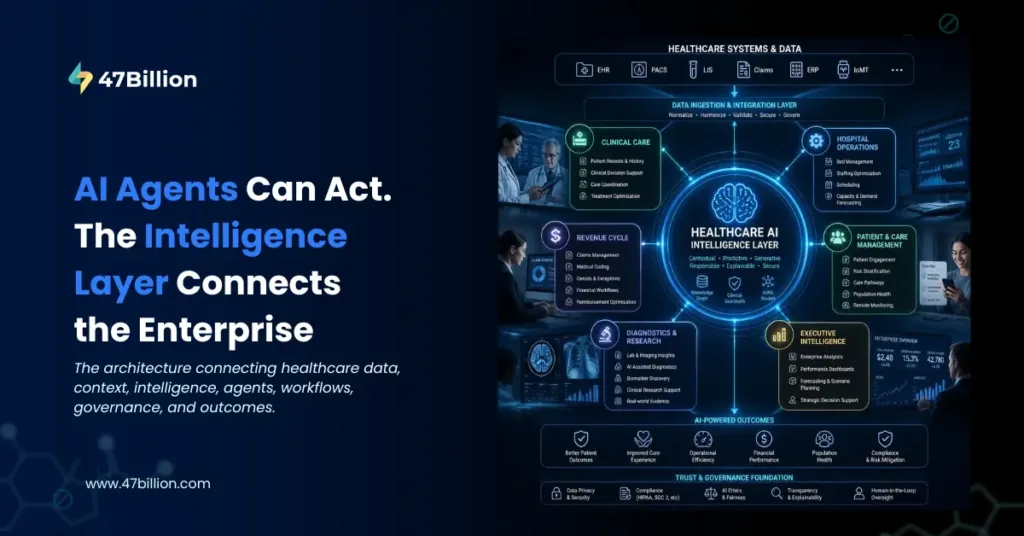
An AI-powered command center is the operational brain of a hospital.
It continuously ingests data from:
- EHRs and EMRs
- Radiology and lab systems
- IoT devices and medical equipment
- Workforce systems
- Patient monitoring platforms
- Bed management systems
- Supply chain systems
- Claims and billing systems
AI models and autonomous agents analyze this information continuously to:
- predict bottlenecks
- optimize workflows
- coordinate departments
- trigger operational actions
- support clinical decisions
- improve resource utilization
Unlike traditional hospital operations centers that depend heavily on human monitoring, AI-powered command centers function as real-time orchestration engines.
They do not simply visualize information.
They operationalize it.
Why Hospitals Are Investing in Command Centers Now?
Several structural pressures are forcing hospitals toward operational intelligence systems.
1. Healthcare Complexity Has Outgrown Human Coordination
Large hospitals run thousands of interconnected workflows every day:
- admissions
- discharges
- transfers
- surgeries
- diagnostics
- staffing
- supply chain operations
- revenue cycle management
Small inefficiencies compound rapidly across departments.
2. Real-Time Decision-Making Is Now Critical
A 20-minute delay in patient transfer can create:
- emergency room congestion
- delayed surgeries
- increased patient wait times
- clinician burnout
- lower bed turnover
Hospitals cannot wait for retrospective reporting anymore.
3. Staffing Shortages Are Intensifying
Healthcare workforce shortages continue to grow globally.
Command centers reduce operational burden by automating:
- coordination
- escalation
- scheduling
- prioritization
- routing
- resource allocation
This allows clinicians to focus more on care delivery instead of administrative orchestration.
4. Financial Pressures Demand Higher Efficiency
Margins are shrinking across healthcare systems.
Hospitals need:
- higher throughput
- optimized asset usage
- lower downtime
- faster discharges
- reduced readmissions
- better reimbursement cycles
AI command centers directly impact these operational KPIs.
The Core Architecture of an AI Hospital Command Center
1. Real-Time Data Integration Layer
The first layer aggregates signal from across the hospital ecosystem.
Data sources include:
- FHIR-enabled EHR systems
- HL7 feeds
- PACS imaging systems
- Laboratory information systems
- RTLS location systems
- Biomedical equipment telemetry
- Staffing platforms
- IoT sensors
The objective is to create a unified operational view of the hospital.
2. Predictive Intelligence Layer
This layer uses machine learning and predictive analytics models to forecast operational and clinical events before they happen.
Models include:
- patient admission forecasting
- ICU demand prediction
- sepsis risk prediction
- OR utilization prediction
- staffing optimization models
- equipment failure prediction
- discharge readiness prediction
Instead of reacting to events, hospitals begin anticipating them.
3. Multi-Agent Orchestration Layer
This is where command centers become transformative.
Rather than relying on one monolithic AI system, hospitals deploy specialized AI agents responsible for different workflows.
Examples include:
Patient Flow Agent
Tracks admissions, discharges and transfers in real time.
Bed Management Agent
Predicts bed availability and prioritizes allocation.
Predictive Maintenance Agent
Monitors MRI machines, ventilators and imaging systems to detect early signs of failure.
Clinical Escalation Agent
Flags deteriorating patients and coordinates rapid response activation.
Staffing Optimization Agent
Balances workforce allocation based on patient acuity and departmental demand.
Claims and Revenue Agent
Tracks billing bottlenecks and predicts denial risks.
These agents communicate continuously with one another.
The result is a hospital capable of coordinated autonomous operations.
Real-World Operational Use Cases
1. Predicting and Preventing Emergency Department Congestion
AI models continuously monitor:
- ambulance arrivals
- patient acuity
- discharge velocity
- ICU transfers
- staffing levels
The command center predicts overcrowding several hours in advance.
AI agents then:
- accelerate discharge workflows
- reassign beds
- reroute low-acuity patients
- notify staffing coordinators
This reduces boarding times and improves patient throughput.
2. Predictive Maintenance for Critical Medical Equipment
One of the most valuable use cases.
Hospitals lose millions annually due to unexpected equipment downtime.
AI-powered predictive maintenance agents:
- monitor telemetry from MRI machines, CT scanners and ventilators
- analyze vibration, temperature, cooling behavior and usage trends
- identify anomalies before breakdowns occur
- forecast remaining useful life of components
- automatically schedule maintenance during low-utilization periods
This minimizes:
- emergency downtime
- cancelled procedures
- repair costs
- patient care disruption
Biomedical engineering becomes predictive instead of reactive.
3. Dynamic Surgical Operations Management
Operating rooms are among the most expensive hospital resources.
Command center agents optimize:
- OR scheduling
- surgeon availability
- anesthesia coordination
- post-op bed forecasting
- equipment readiness
AI predicts delays before they happen and automatically adjusts schedules to prevent idle OR time.
4. Intelligent Staffing Optimization
Healthcare staffing remains one of the largest operational challenges.
AI agents analyze:
- patient acuity
- census fluctuations
- seasonal demand
- nurse fatigue patterns
- overtime trends
The system predicts shortages and dynamically adjusts staffing recommendations.
This helps reduce:
- burnout
- overtime expenses
- unsafe staffing ratios
5. Clinical Deterioration Monitoring
AI command centers integrate continuous patient monitoring systems.
Agents evaluate:
- vitals
- lab values
- medication changes
- nursing notes
- device telemetry
The system identifies subtle deterioration patterns early and escalates care pathways before emergencies occur.
This is particularly effective for:
- sepsis
- respiratory failure
- cardiac deterioration
- post-surgical complications
6. Revenue Cycle Coordination
AI command centers also optimize financial operations.
Agents coordinate:
- claims validation
- coding review
- prior authorization workflows
- denial prediction
- reimbursement reconciliation
Operational intelligence extends beyond care delivery into financial sustainability.
What Makes Command Centers Different From Dashboards?
Dashboards show information.
Command centers coordinate action.
Traditional hospital dashboards require humans to:
- identify problems
- communicate issues
- coordinate responses
- manage dependencies
AI-powered command centers automate much of this orchestration.
The shift is from:
- visibility – intelligence
- monitoring – execution
- fragmented workflows – connected ecosystems
Human Oversight Remains Essential
Healthcare cannot operate without governance.
Well-designed AI command centers:
- maintain human-in-the-loop review
- provide explainable reasoning
- preserve audit trails
- define autonomy boundaries
- escalate critical decisions to clinicians and operators
AI supports operational intelligence.
It does not replace accountability.
The Future: Hospitals as Autonomous Operational Ecosystems
The next generation of hospitals will function less like disconnected departments and more like synchronized systems.
AI-powered command centers will:
- coordinate patient movement autonomously
- optimize assets continuously
- predict operational failures early
- balance workforce demand dynamically
- orchestrate care delivery in real time
The hospitals that adopt this operational model early will gain:
- lower operational costs
- faster throughput
- improved clinical outcomes
- higher workforce efficiency
- stronger financial resilience
Healthcare’s next transformation is not just digitalization.
It is operational intelligence.
AI-powered hospital command centers represent the shift from fragmented decision-making to continuously coordinated healthcare ecosystems.
Hospitals already have the data.
The real opportunity lies in building systems capable of acting on it intelligently, continuously and at scale.
Ready to build a smarter, more connected healthcare ecosystem?
47Billion helps healthcare organizations design AI-powered command centers, predictive intelligence systems, and agentic workflows that drive operational excellence at scale.