From Chatbots to Agents – The Next Phase of Enterprise AI
Over the past few years, many US enterprises have adopted AI chatbots to improve access to information, automate responses, and enhance user experience.
And they’ve delivered value:
- Faster customer support
- Improved employee productivity
- Better knowledge accessibility
But now, enterprise expectations from AI are evolving.
It’s no longer just about:
- Answering questions
- Summarizing documents
- Retrieving information
It’s about:
- Automating decisions
- Executing workflows
- Driving measurable business outcomes
This is where AI agents come in.
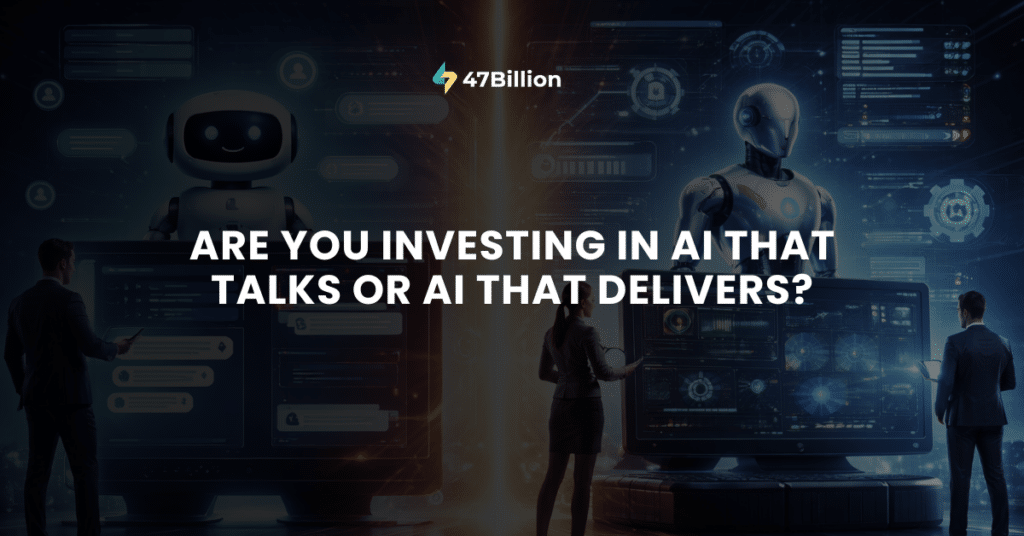
AI agents represent the next phase of enterprise AI – moving from interaction to execution.
Across US enterprises – from healthcare providers and financial institutions to manufacturing and education systems – the conversation is shifting from AI experimentation to operational AI systems that deliver measurable outcomes.
Understanding the Evolution: Interface → Intelligence → Execution
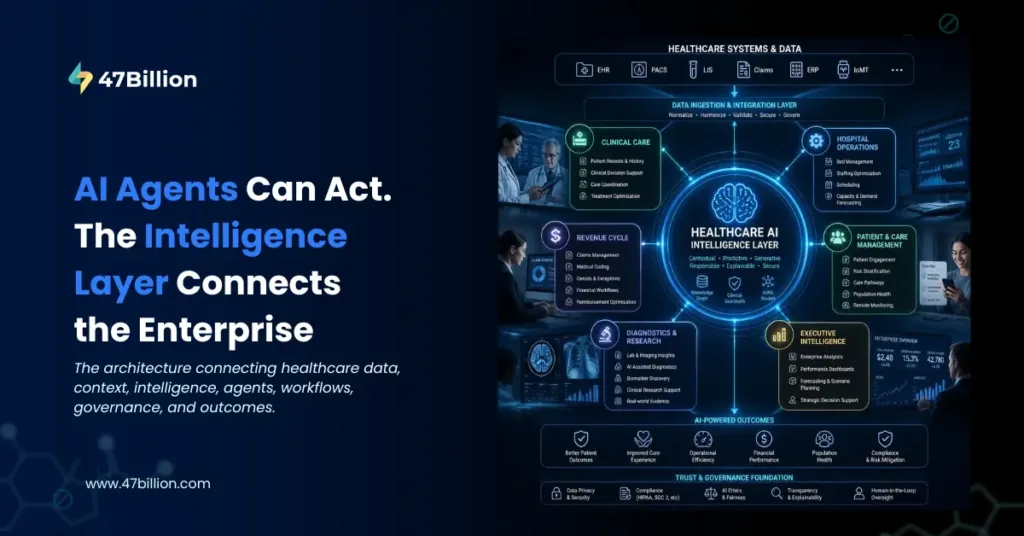
Most US enterprises today have invested in chatbot interfaces and AI copilots, but the next wave of enterprise AI adoption is focused on agentic systems that integrate with core business platforms like EHRs, CRMs, ERPs, and LOS systems.
To understand the difference, it helps to look at how enterprise AI systems evolve:
1. Interface Layer → Chatbots
Where users interact with AI through conversations
2. Intelligence Layer → Models
Where reasoning, prediction, and analysis happen
3. Execution Layer → AI Agents
Where actions are taken and workflows are completed
Most enterprises today operate at:
- Interface + Intelligence
The real transformation happens when AI reaches:
- Execution layer
AI chatbots help you access intelligence.
AI agents help you operationalize it.
What AI Chatbots Do Well in Enterprises?
AI chatbots continue to play an important role.
Key Capabilities:
- Conversational interfaces
- Knowledge retrieval
- Document summarization
- Internal and external support
- Basic task automation
Enterprise Use Cases:
- Customer support automation
- IT and HR helpdesks
- Knowledge assistants
- Policy and compliance queries
- Employee onboarding support
Chatbots improve how people interact with systems.
They are essential – but they are not designed to own workflows or outcomes.
For many US-based enterprises, chatbots have been the first step in AI adoption – improving customer experience and internal productivity – but they are not designed to drive end-to-end business outcomes.
What AI Agents Enable in Enterprise Environments?
AI agents go a step further.
Key Capabilities:
- Goal-driven execution
- Multi-step reasoning
- Workflow orchestration
- Integration with enterprise systems
- Context awareness
- Decision support and automation
- Continuous learning and improvement
AI agents don’t just respond – they act, decide, and execute within business workflows.
This makes them powerful for high-impact, KPI-driven use cases.
Enterprise AI agents are now being adopted across US organizations to automate decision workflows, reduce operational costs, and improve risk management – especially in regulated industries like healthcare and financial services.
AI Agents vs Chatbots – The Business Difference
| Capability | AI Chatbots | AI Agents |
| Role | Interface | Execution system |
| Output | Answers | Actions |
| Scope | Single interaction | Multi-step workflows |
| Integration | Limited | Deep (ERP, CRM, EHR, LOS) |
| Decision-making | Minimal | Advanced |
| Ownership of outcome | None | High |
| Business impact | Support | Operational & strategic |
Chatbots improve access.
AI agents improve outcomes.
Where AI Agents Create Real Enterprise Value?
The true value of AI agents emerges when they are embedded into core workflows.
Let’s look at how this plays out across industries.
Healthcare – From Clinical Support to Care Workflow Automation
Chatbot Use Cases:
- Patient FAQs
- Appointment scheduling
- Medical information retrieval
- Internal knowledge assistants
AI Agent Use Cases:
- Risk stratification agents → Identify high-risk patients and trigger interventions
- Clinical documentation agents → Extract, structure, and update EHR records
- Care coordination agents → Automate follow-ups and care plans
- Claims processing agents → Validate and route claims
Business Impact:
- Reduced readmissions
- Improved care quality
- Faster documentation
- Operational efficiency
AI agents move healthcare AI from assistance to clinical and operational decision support systems. In the US healthcare ecosystem, where compliance, EHR integration, and patient outcomes are critical, AI agents are increasingly being used to support clinical and operational decision-making.
Financial Services – From Customer Interaction to Decision Automation
Chatbot Use Cases:
- Customer support
- Account queries
- Financial FAQs
- Transaction explanations
AI Agent Use Cases:
- Loan underwriting agents → Evaluate borrower profiles and recommend decisions
- Fraud detection agents → Monitor transactions and trigger alerts/actions
- Collections agents → Automate follow-ups and prioritization
- Financial advisory agents → Personalized investment insights
Business Impact:
- Faster decision-making
- Reduced risk
- Improved customer experience
- Increased operational efficiency
AI agents enable financial institutions to embed AI directly into risk and decision workflows. US financial institutions are leveraging AI agents to improve underwriting accuracy, reduce fraud risk, and automate decision workflows while maintaining compliance and auditability.
Manufacturing – From Monitoring to Autonomous Operations
Chatbot Use Cases:
- SOP lookup
- Maintenance support queries
- Training and onboarding
AI Agent Use Cases:
- Predictive maintenance agents → Detect failure patterns and trigger maintenance
- Quality control agents → Identify defects and adjust processes
- Supply chain agents → Optimize inventory and demand planning
- Production scheduling agents → Automate planning decisions
Business Impact:
- Reduced downtime
- Improved product quality
- Cost optimization
- Increased throughput
AI agents transform manufacturing from reactive systems to intelligent, self-optimizing operations. In US manufacturing environments, AI agents are enabling smarter production planning, predictive maintenance, and supply chain optimization at scale.
Education – From Learning Assistance to Personalized Learning Systems
Chatbot Use Cases:
- Student support
- FAQ assistance
- Content navigation
- Administrative queries
AI Agent Use Cases:
- Personalized learning agents → Adapt content based on student performance
- Assessment agents → Evaluate skills and recommend improvements
- Placement readiness agents → Match students with career paths
- Faculty support agents → Automate lesson planning and evaluation
Business Impact:
- Improved learning outcomes
- Better engagement
- Skill gap reduction
- Scalable education delivery
AI agents enable education systems to move toward adaptive, outcome-driven learning ecosystems. Across US universities and education systems, AI agents are helping institutions move toward personalized, outcome-driven learning models.
What It Takes to Build Enterprise AI Agents?
AI agents are powerful – but they require the right foundation.
Enterprise-grade implementation involves:
- Data pipelines and data engineering
- Workflow orchestration
- API integrations across systems
- Domain-specific models
- Prompt + tool orchestration
- Observability and monitoring
- Governance and compliance
- Security and access control
- Human-in-the-loop systems
- Continuous learning pipelines
AI agents are not just built.
They are engineered as enterprise systems.
From AI Tools to AI-Native Organizations
Enterprises are moving through stages:
- Automation tools
- AI models
- AI copilots
AI-native systems powered by agents
Organizations that reach this stage:
- Embed AI into decision workflows
- Improve revenue, cost, risk, and quality
- Operate with AI as a core capability
AI-native organizations don’t just use AI – they run on AI-powered decision systems.
It’s Not Either-Or – It’s Evolution
The question is not:
“Chatbot or AI agent?”
The reality is:
- Chatbots remain essential for interaction
- AI agents drive execution and outcomes
Together, they form a complete enterprise AI system.
Chatbots are how you interact with AI.
AI agents are how AI transforms your business.
Thinking About Building AI Agents for Your Enterprise?
If you are a US enterprise evaluating AI agents, AI platforms, or enterprise AI implementation strategies, the key is to move beyond tools and focus on building AI systems aligned to your business workflows.
That’s where the team at 47Billion works with enterprises – designing and building AI-native decision systems, agentic AI platforms, and domain-specific AI solutions across healthcare, financial services, manufacturing, and education.
From strategy to production, the focus remains simple:
Build AI systems that deliver real business outcomes.
If AI agents are part of your roadmap, this is a conversation worth having.